Townie on a NZ smallholding

Townie on a NZ smallholding

Sunday, 18 May 2014

May 2014


There have been some cracking dawns and sunsets lately, making the descent into winter thoroughly bearable.  Frosts have greeted us for the last 3 mornings, with ribbon mists around the hills, the sunshine bowling in and then moody evening skies.  The first frost heralded the annual sloe-picking pilgrimage, and they’re now safely pricked and steeped in gin.  Billy’s help was invaluable for the sloe harvest this year, as many of them were high up in the thorny bushes.  The brewing wines have all been racked and so far so good – none of them a disaster yet, but it is early days.  I can’t wait to see how the meads mature.


We are getting through some of the items on the gargantuan to-do list of tasks.  However after a few cattle adventures, and the observation that the sheep don’t seem to notice that they are supposed to be penned into specific paddocks, we’ve decided that the fencing needs attention - as in professional attention.  Storms have brought down trees and branches over time, damaging fences which have been fixed up in an ad-hoc way.  The electric part of the fencing has been affected, and the cows are quick to wise up to the opportunities this has provided for adventure.  We’re going to bite the bullet and get a fencer in, in the hope that it’s relatively easily remedied. 

Lots of attention has been lavished on the veg garden.  The pumpkin harvest has been triumphant, though not many people share the view that this is a good thing.  It seems that I’m acquainted with more than the average number of people for whom one pumpkin is too many.  I’m banking on the certain knowledge that those who shun pumpkin soup can often be persuaded to enjoy pumpkin in the form of cake.  This also has an advantage for the cake-maker in the form of a fitness-regime.  Cutting up a pumpkin surely requires more energy than the calorific value of a cake.  Even if you use a machete.
Carrots are still flourishing, and we’ve realised that the one photographed in last month’s blog is frankly a runt compared to some of the mammoth carrots we’re now digging up.  (Are you reading this Karyn?).  Beetroots and a late crop of lettuce are also feeding us, and sugar beets are a real treat for the cows.  Winter crops including onions, leeks, peas, french fennel, spinach and brassicas are sown.  Four of the keyhole beds are cleared and planted with peas as green manure.  Barley straw will be laid on top of them in the hope that weeds will be minimal by spring planting.  More cuttings have been taken from the low hedges as gap fillers for the few that haven’t/won’t survive, and for use in the flower garden and other beds around the house.  So far so good – the hedging is finally starting to take shape.

The orchard trees have been treated to chook poo, vermiliquid (worm wee) and barley straw mulch as part of their wintering down.  One of Peter’s colleagues, Jorgi, came to help out and thrashed down the vegetation along the front fence.  The whole orchard now looks huge.  So huge in fact, that it’s probably in need of a few more trees.  I’m going to research nut trees, as we probably don’t need any more fruit.  The ground there is quite damp as it’s alongside the rain-route from the hill opposite to the wetland.  Hopefully there’ll be some varieties that can tolerate wet feet at times.


Last year’s compost has turned out to be magnificent, despite never having been turned.  I’d planned to add it to this year’s pile on the assumption that it wouldn’t be ready, but once I’d cleared the weeds from the top, the luscious chocolate-cake compost below revealed itself.  It’s been spread over some of the keyhole and fruit beds already, and will be a perfect base for the next batch of seedling compost in spring.  Happily it bodes well for this year’s compost which also hasn’t been turned.  The sunflower stalks have been cut up and put down as a base for the next rounds of composting in the pallet compost boxes.  Hydrangea stems make up the next layer, ready for the usual mountains of weeds and assorted poo to be piled on top of that.
With much trepidation I finally got round to checking out the woodlot, prompted by Peter saying that he could only see a handful of the 50 trees planted there.  Thankfully I’d recorded which plants had gone where, and marked each spot with a bamboo stick.  It was just a case of ferreting around in the weedy growth around each stick to find the tree treasure hidden within.  All up, 4 were (probably) dead and about 6 were missing (the records weren’t completely accurate).  Most of the missing were cabbage trees, some of which were quite small when planted.  The weedy growth has been thrashed away from around each tree, in the hope that they will grow taller than the weeds next year.  Some are a bit misshapen from being squashed by hefty weeds, but they should come right.  I’ll refill some of the gaps with young kahikatea, oak and cabbage tree seedlings which are good-to-go.  It’s very satisfying that the survival rate is considerably better than I’d imagined, and great that this includes the few exotics (liquidamber, witch hazel and sugar maple trees, plus those grown from seed like oak, horse and sweet chestnut) as well as the hardy natives.  Maybe next year it will even start to resemble a woodlot.


Many natives have been cleared from Peter’s work premises, and he’s been able to rescue some of these and bring them home.  They’re currently potted up and will be planted out as a hedge border on the left boundary of our property.  In time they should help to secure that boundary, provide wind and sun shelter and nourishment for bees and other wildlife.  Peter also rescued a fairly mature cabbage tree and it travelled home on the back of the ute, much to the amusement of those who saw it.  It came with a huge root ball, and is now resident in one of the back paddocks close-ish to the house, making up part of the view to the back of the property.  Hopefully it will be happy there.


The beehives are now united into one big hive after the discovery of no brood (and presumably no queen) in one of the hives.  The plan was to divide them back into 2 hives in spring once queen cells are formed.  But when checking fellow beekeeper Neville’s hives, we discovered 3 queen cells.  After professional advice and deliberation we decided to attempt to transfer the queen cells to my vacant hive rather than wait until spring to get a new colony started.  The chances of this being successful were small, though the risks too were small.  In the event, the queen cells were no longer there when we went back for them a few days later.  Disappointing really, but great that my beekeeping knowledge has increased enough to consider being experimental.  The online apiculture course is partly responsible for that confidence.


The West Coast was magical as always, and even came with pretty good weather this time. I was there for a few days on my own before Peter dropped Sam and Billy off. Their highlight was a cave-rafting trip near the small coastal town of Charleston. I’d have loved to have joined them but figured that being on call but having no cell phone signal in a cave probably wasn’t very professional. Next time perhaps - we’re expecting Rachel, Jif and the boys for Christmas and plan to spend a few days there.


Mother’s Day on May 12th was special and simply delightful.  Lucas paid a lovely surprise visit and stayed for a couple of nights.  I was woken up to breakfast in bed, and Billy resurrected ‘David Beckham’ as my waiter.  We went for a picnic at the Onamalutu Reserve down the road, taking the fantastic ‘posy’ of cupcakes which Sophie had made. The sun shone and the place was deserted except for us.  It’s still hard to believe that somewhere so pristine and beautiful is just on our doorstep.  I collected lots of native seeds as there were berries a-plenty, and voila – yet another project.  Now they’re sown I guess I just have to remember to water them.  Shouldn’t be too hard. 

Despite the endless list of tasks, there’s still a sense that progress is happening.  Peter does his best to inject some reality about what it’s possible to achieve, gently suggesting that we complete one project before launching into another one.  So radical.  I know he’s right, but he has also been known to observe that I’m never happy unless I’ve got too much to do.  New projects are driveway re-gravelling, and sorting out the plant bed at the front of the house (digging up over-grown and over-flowing plants/grasses, planting a hedge and re-planting with happy bee-loving plants).  Lazy Mazy is still awaiting her make-over, and the veg garden just needs about a solid week of work.  Dreams of a greenhouse are more persistent, though much ground work in terms of wind protection will have to happen first.  In the meantime the season progresses and brings its magic.  The morning drive down the valley to the school bus stop is breath-taking, especially on a chilly morning when the sun is burning up the cool night mists.  Such an uplifting start to the day.  Such a privilege to be here. 
 

Wednesday, 16 April 2014

April 2014


The clock change and about 10 days of rain (with more heavy rain warnings forecast) make those heady sunny days seem long gone.  We’re seeing (and hearing) a lot more of this weka now the ground is damp.  Pukekos and kingfishers are also showing up, and one day there was a heron by the veg garden ponds.
The tulip tree has finally had the haircut it needed - a pretty severe short back and sides. Peter hacked huge limbs off with the chainsaw, going back and forth taking extra bits off to balance it out, ending up chopping off a lot more than planned.  We used rope to guide a couple of the biggest branches, and at one point had to tie the rope to the back of the ute for extra traction.  Thankfully no humans or cows were harmed in the process. In fact, even the washing line which was tied to a lower limb was left unscathed, and the cows really enjoyed munching their way through the tulip foliage.  The tree pruning has provided some momentum for trimming back several other overgrown shrubs in the garden.The task is by no means complete, but getting started is a pretty big step.
Just before the rain came down, the flower garden got a thorough weeding, new perennials were planted, and clover straw laid down.  More cuttings have been taken to use as low hedging around the flower bed (dwarf lavender) and around the other planted beds (teuchrium).  These beds are currently edged with flattish river rocks which get overgrown with lawn weeds and wreak havoc with the strimmer.  Using living boundaries instead will also provide extra bee nutrition, though it will be next year before they’re ready to plant out. 

Optimistically the sand-fly population will begin to diminish.  They’re a serious nuisance and there is no exposed bodily part that is safe.  Even when I’m sweating under more clothing than the temperature warrants, they still find a way.  Flying into my ears and up my nose happens frequently, and so does taking a bite out of my lips.  It’s surprising that no cosmetic company has yet realised the potential of ‘sand-fly-stung-lips’ as an alternative to bee-stung lips.  Maybe it's just too effective.


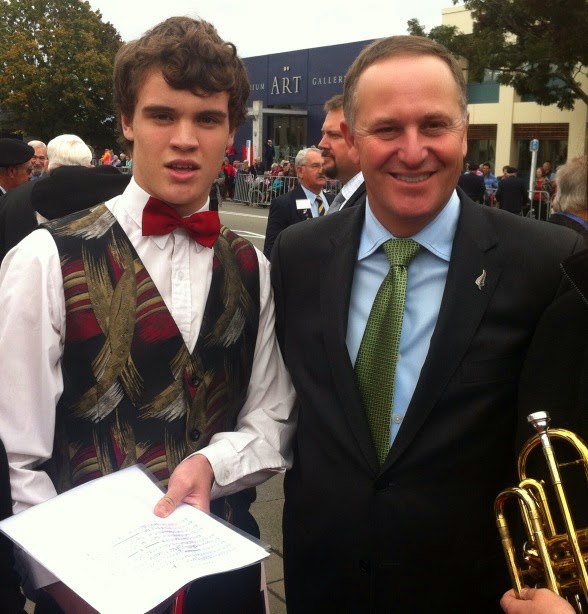
Blenheim proudly hosted a royal visit from Prince William and Kate.  Unfortunately I had some urgent weeding to do, so didn’t turn up in my union jack undies.  Sam was playing in the band, and Billy joined the crowd along with his school mates.  They didn’t get to chew the cud with royalty, but Sam had a chat with PM John Key.  He didn’t remind John about his 2010 meeting with me and my spare vagina; I’m not sure why.


The grape vintage is now mostly over, and Peter’s back to working in the winery.  One evening during the harvest we popped out to see him.  Sam and Billy were invited to ride on the harvester, pretty darned exciting for them.  Peter managed to get hold of several buckets of surplus grapes, which are now bubbling away along with several other home-made wines – peapod, peach, crab-apple, plus the 3 demi-johns of mead.  As usual I got a bit carried away, but hopefully at least some of them will be drinkable in a few months.

Whilst the wet weather has significantly reduced the watering workload, it has increased the weeding workload, which won’t be dealt with until the sun dries the ground up a bit.  Hopefully the rain will result in a good flush of paddock herbage before colder weather sets in.  The veg garden remains productive – just look at the size of Peter’s carrot!  Several mushrooms have appeared in the damp wood chip paths, including these shiny reddish ones which popped up just outside the gin palace.  The orchard is nearly ready for the sheep to graze.  The smaller fruit trees now have protection in the form of pallets, tied together in triangles around them.  Hopefully that’ll do the trick, though it’d be a mistake to underestimate those clever sheep.


The 3 adult cows (Aphrodite, Persephone and Hera) have all been inseminated, though we won’t really know if that’s been successful for a while.  Persephone was last up and received Galloway semen.  We’re hoping that at least one cow will sell as we’re already potentially over-stocked.   My nephew Arthur, who has an interest in Greek mythology, has been charged with the responsibility of making a short list of names for the new arrivals.  If we get a girl, I’m keen on ‘Minthe’ because of her story*. 


There has been a reduction in cattle numbers - Butch had a visit from the home-kill man.  It was a very unsettling and emotional day.  I’d planned to be out, but he came early in the morning before we’d left for the school bus.  The shot rang out very soon after his arrival, which was probably the kindest way for Butch.  He was a huge steer and should provide heaps of meat, which I’m trying not to think about right now.   Aphrodite seems to have taken command of the herd as its matriarch.  Maybe Zeus will attempt a coup when he’s bigger.

Easter’s nearly here, and Lucas and Sophie are spending a few days with us (and Sophie’s family).  In their honour, the sleep-out has been cleared and cleaned and is now actually habitable by human-kind as well as mouse-kind. The photo is here as evidence that it can look like a real room and does not have to always be a tip (ahem…).  None of the kids appear to have grown out of Easter egg hunting, so ‘muggins here’ has had to negotiate with the Easter bunny again to organise an early morning hunt.   I’m looking forward to heading over to the West Coast next week to do some midwifery work.  Peter will bring Sam and Billy to join me for a few days, and we’ve got some lovely accommodation booked just outside the town.  Optimistically I’ll get a bit of down-time to enjoy the serenity and native bush in one of my favourite places in the world.

We’ve lit the fire a few times, though it’s more of an indulgence as it’s not really cold.  It’s just scrummy to draw the curtains, don pyjamas, eat chocolate and watch the flames.  Happily the damson gin is ready to warm our cockles, and certainly doesn’t disappoint. 
Winter – bring it on.
 
*According to the story, Minthe was a beautiful water nymph who attracted the attention of Hades. Hades was the stern ruler of the Greek Underworld and the husband of the goddess Persephone. It seems, however, that even Persephone’s obvious charms could not keep the attention of Hades at all times. The Underworld god therefore engaged in an illicit – but not terribly well hidden – affair with the Naiad Minthe.
Naturally, Persephone found out about the relationship between her husband and the water nymph. And in a scenario that is all too familiar in Greek myth, the spurned wife took revenge on her husband’s mistress. Minthe became the unfortunate object of Persephone’s wrath. The goddess of the Underworld began to step on Minthe, beating the poor Naiad with furious kicks. Minthe however was transformed into the mint plant, and with each tread of Persephone’s foot, this plant released a delightful scent. This is the myth of how the aromatic mint plant received its name.

Sunday, 23 March 2014

March 2014


The month began with an unleashing of nature’s forces.  On Sunday 2nd I was happily planting out winter veg seedlings during the heat of a sweltering 26 degree day.   The next day I drove down to Christchurch.  The sun was shining, the east coastal route stunning as always.  At 4:30pm Billy rang from home to say it was hailing.  5 minutes later the hail was joined by lightning and cracks of thunder.  20 minutes later it was all over and the ground was a white-over.  Billy took this photo showing the size of the hail stones next to a marble.  I escaped Christchurch the next day as the roads were beginning to flood.  They continued to flood until roads became rivers, and rivers became roads.  Many buildings and structures were waterlogged.  A one-in-a-hundred-year flood apparently, that Christchurch could do with like a hole in the head.  Lucas, along with many other Cantabrians, didn’t go to Tech or to work because both places were closed.

The bees look to be battening down the hatches for the autumn.  Each hive has its varroa treatment in situ (Bayvarol) and there’s less brood.  Upwards of 7kg of honey was extracted from 6 frames – too much for us to eat, too much even to give away.  One obvious solution came to mind – mead.  There are plenty of recipe ideas on the internet, so now I’ve got plain mead, vanilla mead and orange clover mead bubbling away in demi-johns.  They should be ready for racking in 4 months.  It’s really exciting to be back making wine again. 

Alongside the plum tree is a peach tree, which also had a great crop of fruit this year.  A big storm was forecast (from cyclone Lusi) so we stripped most of the peaches.  The storm didn’t match up to the severe weather warning, but we did end up with 19.4 kg of fruit.  Quite a haul.  Around the same time I picked all the remaining orchard fruit – nashi pears, Bon Chretien pears, eating apples and cider apples.  The pears have been preserved in honey syrup in jars and the peaches have been transformed into a few things – jam, jarred peach slices, and of course, peach wine. 
Whilst looking through wine recipes I came across a few old favourites.  Peapod wine was particularly memorable and it’s an ingredient that is and will continue to be, abundant in the veg garden.  Pumpkin wine might also have to be brewed, in the interests of using up what’s available.  Vintage (grape harvest) is about to begin in earnest.  Peter will be working night shifts as a MOFO (mobile operation field officer) on the vineyards, which could give him access to surplus grapes.  In the last few years, wineries have been buying a specific volume of grapes, rather than all the grapes on a site.  Any excess might be left on the vines if they don’t have the capacity for more.   Fingers crossed that Peter can bring some home, and then I can take the unusual step of making wine from grapes.

The chook house/run is complete and occupied by the young Rhode Island Reds and the Cochins.  We’ve decided to keep the Cochin rooster (Cornelius) and some of his harem.  Hopefully in spring we’ll get a variety of chicks, some pure and some mixed breed.  Derryn came round and we plucked 4 chooks (including Bob Jnr) that Peter killed.  Not a pleasant job at all, and we only used the trick of plunging them into boiling water for the last one.  It worked a treat – the feathers came out much easier.  We’d tried using hot water before, but it didn’t work then.  Boiling water is obviously the key. 


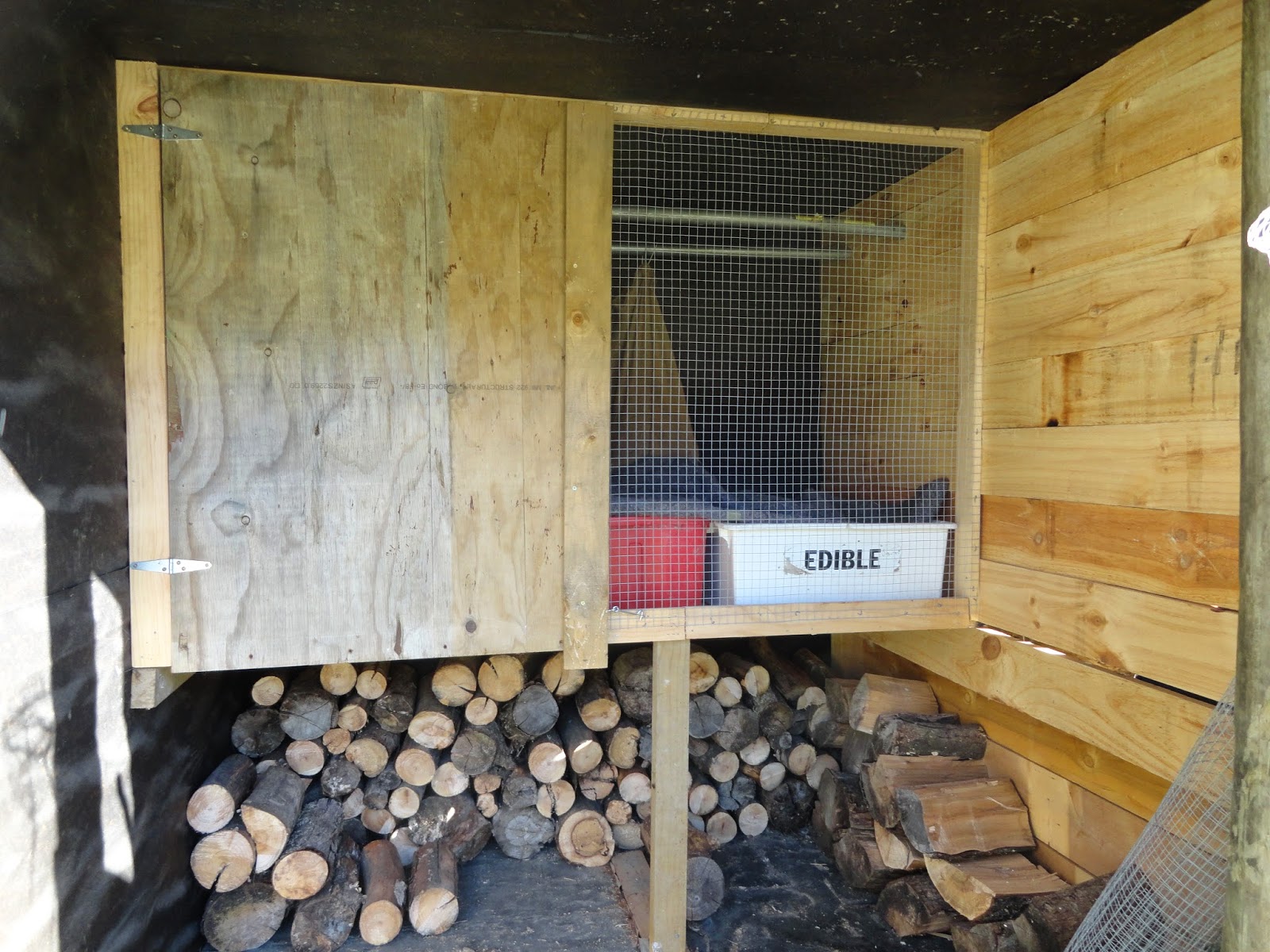
The other half of the converted box has now been transformed into a storage area.  There’s space for firewood, which will provide us with a good dry supply relatively near the house, and a huge shelf, wire-netted to keep the contents safe from rodents.  There are also a couple of bars which we can hang sacks from.  Right now it’s home to some of our (credit where it’s due - Peter’s) vast potato crop, but in future it should be good for fruit and veg (root veg /corn/
pumpkin etc) storage.  There’s also the potential to extend the shelf if needed.  An interior fly-netted space will eventually be added for meat hanging (salamis, prosciutto).  

 
During construction Billy laid down on the shelf and in a crappy Geordie accent declared that there was ‘loads of room and I’m 6 foot 3’.  Gorgeous Geordie George Clarke’s series ‘Amazing Spaces’ has reached NZ and I’ve been transfixed and full of ideas for Lazy Mazy the caravan.  It seems that I’m not the only one in the house to enjoy it – Peter had laid on the shelf a couple of hours earlier and come out with exactly the same quip (only with a slightly better accent).
 
Talking of prosciutto, I finally plucked up enough courage to open up the prosciutto from one of our pigs that I salted and hung last July.  It was a worry that it might have gone off and a huge slab of meat wasted.  As the muslin cloth was opened, the delicious aroma of prosciutto became apparent.   Happily it’s absolutely delicious.  It was a difficult job slicing it, but the $25 meat slicer that Peter bought from a 2nd hand shop proved its worth.  Billy helped to pack the thin slices into vacuum bags.   The salami was less successful, way too salty.  That must be down to my lousy maths – you have to carefully calculate the volume of salt to meat.  A shame, but I don’t intend to get it wrong again. 
 
The freezer’s getting decidedly sparse, and Butch is next on the home-kill list. I’ll definitely have to be absent for the event – he’s become part of the farm and endeared himself into our affections. Despite his threatening stare, he’s mostly a big softie and definitely a big character. However we don’t have the capacity to feed 6 cattle over winter, so it has to be. If we end up with 3 pregnant cows then hay supplies will need more careful targeting. So far Aphrodite and Hera have been inseminated with Speckled Park semen (mistakenly for Aphrodite who was supposed to receive Galloway semen). Hopefully Persephone will be on heat soon – if so, both her and Hera’s calves will be due around Christmas.  Zeus is growing bigger by the minute, with no sign of his damaged leg from birth.  Though it was an unpleasant thing to do, I'm mighty glad that we castrated him when he was young or he'd already be a formidable bull. 
Yet another tragic rabbit story to report this month. Security in the hutch housing an adult female and 3 kits was breached, and they all escaped into the night. When I went to feed them in the morning, one was lying dead in front of the hutch, mutilated. A second was dead in the next paddock and a third in the animal shelter. The adult rabbit returned whilst we were taking in the carnage, and practically ran into my arms. She looked like she’d been in a fight but seems to have recovered. Peter believes it to be the work of wild cats, which we sometimes see. It was so excessively cruel and unpleasant, and deeply upsetting. At least I feel a little bit more justified in keeping them in hutches/runs safe from predators. 

The veg garden is still beautiful, but still only to me.  It’s untidy but productive, though there has been a little bit of clearing up.  The potatoes are harvested and the beds thickly sowed with pea seeds.  The hedge cuttings have now been planted around the beds, even the box which is painfully slow growing, so the cuttings are still tiny.  Hopefully they’ll take off.  There aren’t enough lavender plants so I’ll take another batch of cuttings to complete the circle.  The globe artichokes have been stunning, and many of them have been left to flower to be enjoyed by the bees.  Beans have been picked and eaten or blanched and frozen.  Pumpkins are maturing and carrots are BIG (eat your heart out Karyn!).  Tomatoes have been roasted with onions, garlic, herbs, seasoning and a sprinkle of honey, then blitzed into sauce and frozen in jars.  Courgettes and marrows persist, mostly being fed to the appreciative chooks.  The asparagus ferns are still alive, maybe even flourishing, so hopefully will crop in the next few years.  It’s indeed a busy time of year and I’m looking forward to putting a big chunk of the veg garden to bed over winter. 
 
My academic leave is just beginning and hopefully that means there’ll be a bit more time to spend on the farm.  Autumn tasks like food preservation are kind of on track and we’re prepared for winter in terms of firewood and animal feed.  Still lots of sunshine, but the days are definitely drawing in and there can be a chill in the early morning air.  Maybe, just maybe, this will be the year when we get organised and on top of the work.  Yeah right….dream on.


Sunday, 16 February 2014

February 2014


It’s been a glorious February so far, and a dry one too.  The day time temperatures have rarely been below about 24 degrees.  So it's pretty warm, and when combined with clouds of pesky sand-flies, outdoor work has been somewhat challenging.   Paid work is also seriously hindering what outside progress might otherwise be made, though at least the boys are back to school.  The tasks of driveway weeding and preservative-painting of the balcony must be the least popular as they’ve been totally ignored despite being on the priority list for months.

The new chook-house and run is beginning to take shape.  The aviary idea has been binned (won’t go there…) and instead the space in the crate unoccupied by the chooks will be a wood and vegetable/fruit storage area.  I’m getting quite excited about the prospect of building a raised and netted box with shelving to store our winter supplies.  It’s fair to say that plans are still in the conceptual stage, though that’s probably the most exciting.  In the meantime the chooks are healthy if not a little cramped.  One brave hen has decided it’s time to brood, so we may end up with even more chicken dinners.


The lambs are sold and gone to pastures new, leaving us with our original 4 ewes and Rambo, and the 2 boy lambs which will be in the freezer by Easter.  We finally bit the bullet and got round to shearing the worst of the non-shedding wool from the 3 ewes who were clearly in need of a summer outfit.  Once again it was a task and a half, not least because the cheap shears we bought last year, in anticipation of only a little use, are now seriously crap.  The shearing-whilst-wedged-up-against-the-fence technique was re-introduced for those ewes who refused point blank to remain lying down for long enough.  Sadly our standards of shearing haven’t improved since last year, so those shorn look like they’ve been mutilated.   That said, when all the sheep are together, they don’t look that much worse than those that have messily shed some of their wool themselves.  


The cattle have been un-troublesome for a while now.  They’re probably deep in the planning stage of their next adventure.  Athena and Zeus have grown considerably, though are still pretty cute (but probably only if you like cows).  This year’s hay pastures are re-growing beautifully – bright green and with a range of pasture plants.  The dastardly grass-cutter was fixed, and the go-kart goes, but is stuck in a high gear so can’t pull the weight of the cutter.  The interim solution is to use the car to pull the grass-cutter – it’s effective though does look a bit unusual trawling through the paddocks.  Hopefully we’re in time for a bit of fresh growth before everything slows up in autumn.

The plums are now over but we have plenty of plum jam to see us through the winter as well as plenty of plums frozen to use in baking.  The damsons were starting to soften, so they have all been picked (bar a few left for the birds) and steeped in gin.  They were frozen overnight first, in the hope that this would help release the juices.  The photo shows the gin on day 1, looking a bit like a snow-scene.  Less than a week later it's already a gorgeous soft pink.  It’s my first ever damson gin and I’m looking forward to seeing how it compares to sloe gin.


The veg garden is still productive, with most of the plants either ready for cropping or getting there.  We have spuds for Africa, miles of beans (yellow bush, soy, runner and borlotti) and peas.  The pumpkins, which were grown from seed saved last year, have created a jungle of vegetation which is threatening to overspill into the entire garden.  The pumpkins themselves are pretty impressive too.  They’re in the keyhole bed which was supposed to be a corn circle.  What’s left of the corn crop hasn’t grown tall, but the cobs look to be a good size.  There’s one more batch of seedlings to plant out which will be the last to be planted this year – mostly brassicas, but also more lettuce and beetroot.

Derryn and I have started our Apiculture Knowledge course and it looks to be pretty comprehensive.  The bees remain delightful and I’ve continued to harvest small quantities of fabulous honey and wax.  The bee club met at our place to look at honey extraction and autumn varroa treatment.  We used the centrifugal extractor for Doug’s manuka honey, and scraped out and sieved one of my frames.  The honey is potted up, and the wax was washed with cold water and put in the freezer.  Once I have plenty of wax, and I’ve built a solar wax filter, the wax can be fashioned into candles and face cream (to avoid disappointment I’ll give myself 5 years to get round to this).


The tobacco that was harvested a year ago was finally dry enough for the next phase of the processing.   A pretty technical phase actually, involving my bare hands, a pasta maker and no skill whatsoever.  The tobacco leaves were torn from the main woody stems, and then fed through the spaghetti roller to be shredded.  The precious and sweet-scented tobacco has been gifted and I’m awaiting feedback on whether it’s worth doing again. 


One of my top ten parenting tips is to be so bad at doing something that the kids feel obliged to take over in order to avoid humiliation.  Sewing is a case in point.  My standard for the sewing-on of scout badges is so low, that one by one, all the boys have eventually decided to do their own.  Billy has heaps of badges, mostly from the Jamboree, which he wants to be displayed on a blanket.  He learned to use a sewing machine in Technology classes at school, so here he is getting on with the task. 

 
On a personal note, I’d like to confess that my hair hasn’t been washed in 3 weeks.   What I mean is that I haven’t used shampoo for that time.  A little research revealed that hair-washing with baking soda and rinsing with apple cider vinegar are effective alternatives until your hair balances out its natural oil production and self-cleansing capacity.  It’s known as going ‘no poo’!  Probably that’s only so that those with a seriously toilet sense of humour can enjoy the double-entendre concept of calling it ‘the no-poo movement’.  It allegedly takes weeks or months to get to the point of being able to use only water, and in the meantime it can be pretty challenging.  So far so good – my hair feels a bit strange and it may have a faint aroma of vinegar, but it’s not been unbearable.  Watch this space…

The flowers in the photo were a gift from the UK with a NZ twist.  They were delivered by Hayley, whose surprise arrival was just in time to meet Peter, but alas I was in Christchurch.  Hayley has recently moved to Wellington and is Janet’s (now Graham’s wife) daughter, and for me, a lovely connection to my friend Joanna and her family.  It was a very pleasant and emotional surprise indeed.  Joanna was a truly special person and gifted midwife, and is often in my thoughts (the Rosa Remember Me and true-blue forget-me-nots are always a happy reminder).  So cheers to absent friends and family - long may you continue to positively influence my thoughts and actions.