Townie on a NZ smallholding

Townie on a NZ smallholding

Wednesday, 20 August 2014

August 2014

Beautiful Maggie

The days are getting longer, though we’re far from being done with frosty mornings.  Madame Cholet, the tunnel house, keeps cosy warm though.  The seeds I planted a little while ago have germinated and are coming along well.  Some are about ready for either pricking out into individual cells or planting out directly. Several more seeds are sown, including some flowers.  The straw bale beds don’t look much different, but it was very easy to create holes with my hand and plant some tomato seedlings.  Inside the bales it was warm, soft and soil-like.  This is definitely my favourite phase of gardening – beautiful delicate seedlings with so much promise and no disappointment yet.


All of the ewes have had twins, but sadly we were faced with the old adage of ‘where there’s livestock there’s dead stock’.  The last ewe to birth had a ram and ewe twins.  The ewe lamb died during its 2nd night, and we’re not sure why.  It was quite a wicked night – wind and rain followed by a frost.  Perhaps the lamb got separated for too long from her mum.  Peter thought that she’d had an unusual bleat, so there's a chance it was never meant to be.  She’s buried in the wetland under a kahikatea seedling.  There was a little ceremony, a celebration of her short life.  A few tears were shed.


The remaining 7 lambs are all boys.  They’re robust and old enough to be mischievous, and can get through the fencing into the veg garden.  There’s not a great deal to nibble in there, but they’ve enjoyed the beetroot tops and the brassicas.  Their utter cuteness means that it’s impossible to be cheesed off with them for long.  Every day they have a sequence of happy hours, charging and bounding around the paddocks, closely watched by their mums.  With the help of Karyn (shepherd) and Emily (the Vaccinator) we rounded them all up for tail docking, castration and vaccinating.  We decided to go ahead with tail docking of our new lambs until we’re sure that they’re all full-shedders of their wool – which Wiltshires are supposed to be.  We’d previously assumed this to be the case, and then ended up mutilating the poor critters with our hand shears.  Castration will allow us to keep the boy lambs for longer, and we were advised by the vet that we probably should vaccinate if we’re lopping bits off.  There was a modicum of chasing around to catch the lambs, but essentially it all went rather smoothly.  For us at least – the lambs weren’t impressed.

The final lamb from last year was dispatched, and then butchered by Peter.  There’re plenty of lamb joints in the freezer, and another large batch of lamb sausages and patties.  Aside from a rabbit or two, that’ll probably be the last round of meat production for a few months.  We’re down to 8 chooks right now – 2 roosters and 6 hens.  Derryn is raising another clutch of chicks which will find their way here in time.  I’m hoping that our hens might decide to go broody so that we can have our own chicks.
 
The rabbits are all thriving.  There are 7 kits in the recent litter and they’re growing fast.  We had an escapee adult who went on walkabout for a few days.  We didn’t think it was in with any chance of survival – a bright white bunny among the hawks.  But with a degree of poetic justice it turned up the same morning that the ewe lamb died.  Sam and I managed to round it (eventually, despite a pretty ineffective though very lively rabbit-catching technique) into the vacant chook mobile, where we suspect it had already been making itself at home. 

The beds in the veg garden are now sorted – either covered in barley straw or growing winter crops.  Some areas of the path still need to be completed, particularly around the pump shed.  The circular fruit bed (raspberries, blackberries and boysenberries with a central ballerina crab apple and step over espaliered apples around the perimeter) is well tidy now.  The straggly berry stems are tied into the netting and the ground mulched with straw.  Hopefully it’ll be easier to maintain in the long run (thanks Karyn!).

Another garden bed has been tackled. It’s the part of the garden that makes up our view to Mt Riley and had become seriously overgrown.  It’s planted in natives which have now had a severe short back ‘n sides.  The bed itself has been widened and extended, and planted with some of the natives that Peter acquired from work and a few dwarf flax that I raised from seed.  I've got rid of an old square raised bed that sat on the edge of the garden accommodating strawberries and lots of weeds.  It’s going into the horse arena to become the first raised bed in there.  It’ll be blessed with some of the several fruit bushes that were gifted by Ange and Matt who are immigrating to Aus – gooseberry, raspberry and currant.  There were also a couple of pear trees, grown from pips by their daughters in the millennium which have already been planted in the orchard. 

The native planting in the wetland is definitely coming away, visible now from a distance as well as close-up.  The lambs can get in through the fence and pruned a few tender leaves, but damage to the natives isn't too bad. There are parts of the wetland where none of the natives we planted have survived.  The plans are to concentrate on the areas where they are thriving and plant more in those places in the hope that once established, the natives will procreate. 

The tagasaste trees in the newly-planted woodlot adjacent to the wetland must be really tasty tagasastes.  At least the chooks think so.  They've stripped every last green leaf so they’re now just sticks in the ground.  I've attempted to protect them by setting up wigwams of old wire netting around them, though it’s probably already too late.  All of the new trees have got wool mulch mats, to give them a bit of a head start before the rampant weeds kick in.


At home, Sam celebrated his 17th birthday.  He requested a ‘double lolly cake’ – a NZ lolly cake formed into a circle and filled with lolly sweeties.  He didn't quite get that.  In honour of his penchant for creating turds, the lolly cake was instead shaped into a giant turd.  It was actually quite effective, and I’m sure there’s potential to develop the concept - chocolate cake would lend itself well to the theme.

Having gone ‘no poo’ for many months now, it was heartening to see some publicity on national TV news.  A book called ’Happy Hair’ has hit the headlines.  It’s about the experiences of using shampoo alternatives which don’t wash away your hairs’ ability to cleanse itself.  Nowadays I wash with baking soda and rinse with apple cider vinegar every 5-6 days.  In between it just gets a wash and scalp massage using water, and it gets brushed a lot more than ever before.  For a bad hair day I use a dry shampoo made of arrowroot and cocoa powder.  I concede that I’ve never been renowned for the glossy shiny slickness of my hair – it’s more of a raggedy mop really.  But it’s no more of a mop than it was when I was spending money on hair products.  Must have saved a fortune on shampoo and conditioner. 

Mornings are particularly picturesque times in winter/early spring here on the farm, especially when the frostiness gives way to the morning sun.  Though there are many times when I just don't want to go out into the cold and do the round of animal feeding - again - it's always a pleasure when I get outside, no matter what the weather's doing.  I'm grateful that there's always something to do, in fact lots of meaningful somethings.  It's much better than wondering how I'm going
to fill my day, or filling it with only work and screens.  Being surrounded by things that are waiting to be done is a small price to pay for the privilege.


'It is still a beautiful world.
Be cheerful.
Strive to be happy' 

Max Ehrmann (Desiderata)


Monday, 21 July 2014

July 2014


We’re currently in the midst of a cold snap, probably the coldest winter since being in New Zealand.  For several days every morning's had a frost, and more forecast to come.  There's no rain on the horizon, so little chance of clouds keeping the night temperatures up.  We've been blessed with plenty of sunshine though – beautiful crisp winter days.  The evenings are warmed by the wood-burner stove, and it’s pleasantly cozy inside as long as you haven’t hung around outside for too long after the sun goes down.  Mornings are the most challenging.  The frost doesn't lift from the shadier parts of the property until late morning.  We have to use a spade to prise the frozen lid off one of the rabbit runs to feed them.  Their glass water containers are completely frozen every morning, except for when it's been cold enough to shatter 3 out of 4 of them.  Optimistically it’s also cold enough to seriously hammer non-beneficial bugs and pests.


Happily the 2 sets of twin lambs born last week are being well-mothered.  They made a good decision to be born during the day, so at least had chance to be licked dry and fed several times before the temperatures plummeted.  The first twins (2 boys Peter and Tom - a Beatrix Potter theme courtesy of Karyn) were born a year and a day after last year’s first lamb (Hagrid) put in an appearance.  You forget what absolute bundles of joy they are, gamboling around the paddocks, vigorously shaking their little tails as they feed.  It’s great when they hang around within view of the kitchen window – that level of distraction almost makes washing up bearable.  The two remaining ewes will hopefully birth soon – one looks considerably more imminent than the other.

We’re also delighted to have rabbit babies, though we haven’t seen them yet.  Their mother built an impressive nest as far back into the hutch as possible, pretty much at the end of arm’s reach.  In the photo they're deep down in the straw, under the plucked white rabbit fur.  So far we know that it’s warm and wriggly in there, and await the new arrivals introduction to the big wide world.  Also we now know for sure that we have at least one male and one female adult.  We've put what we think is a female in the hutch of what might be a male, in the hope that we’re getting there with sexing.  One disadvantage of not being sure is that we have to separate them into individual hutches, which makes for time-consuming feed rounds (and the need for lots of water containers).

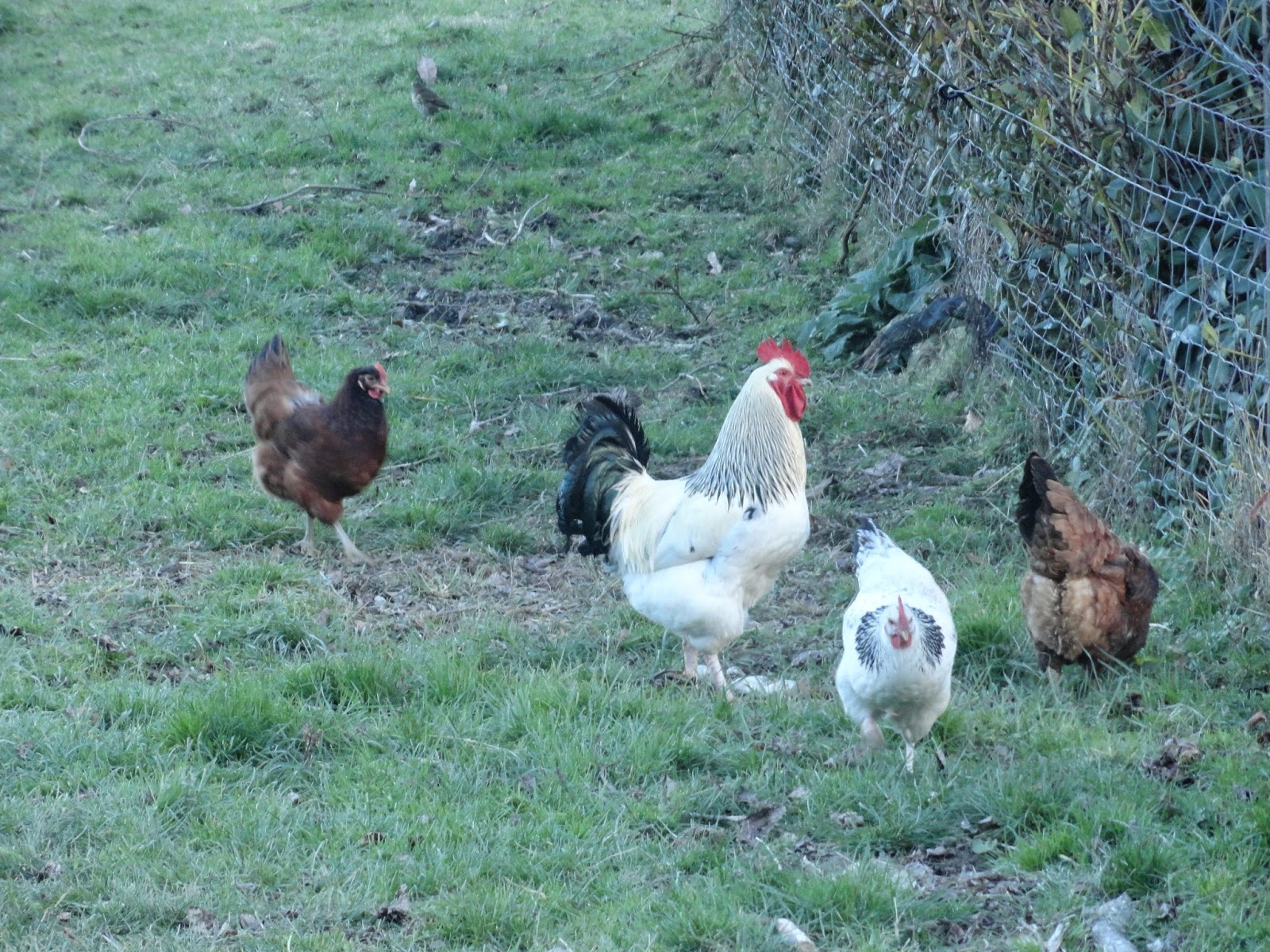
The chickens are getting more adventurous - not good news for their free-ranging longevity.  Whilst it’s lovely to see them strutting around in the paddocks and the orchard, it’s not so enjoyable to watch them scratch and kick the carefully lain straw all over the place.  They’re not beyond digging up new plantings either.  We've taken to letting them out mid-afternoon, in the hope that they won’t cause too much damage in the few hours before dusk.  The two roosters, Bob Jnr and Cornelius (pictured) seem to get along OK, and we’re getting plenty of eggs for our own consumption and for gifts.


Peter received an invitation he just couldn’t turn down – the opportunity to practice ‘Artificial Insemination’ on Betsy the (model) cow.  The company who provides our semen straws were having a stall at the Hokitika AgFest and bringing Betsy along.  It was a long but stunning drive to the West Coast.  The event was impressive and Betsy a joy.  I was relieved to be able to locate her cervix quite quickly – very similar to a human cervix, though I don’t usually find those via the rectum.  Peter managed to inseminate her efficiently too.  Maybe one day we’ll put this into practice on our own cows.


The veg garden has received scant attention in the form of straw application to a couple of the keyhole beds and the fruit bushes.  There’s still plenty more to do, but that’ll have to wait until we get more straw.  We’re still harvesting carrots (huge and oddly shaped - we've had lots of carrots with an extra appendage, but so far this is the first 'bury me in a Y shaped coffin' carrot!) and beetroots; otherwise there’s unsurprisingly very little growth of the late summer plantings.  The compost heap has also been covered in an overcoat of straw, and the old trampoline mat re-applied on top.  Fingers crossed for delicious compost next year.  In the meantime, this year’s compost has been added to river sand, fine pumice and peat to create mountains of glorious seedling compost. 

The nuttery is no longer a figment of my imagination!  The original 2 hazelnuts are now joined by 2 almonds, 2 sweet chestnuts and a walnut (with another walnut ordered).  They’re planted, staked, mulched with straw and welcomed to their new home.  They’re all grafted trees so hopefully will crop in the next 3 years.  All you can really see in the photo are the stakes and the pallet triangles around the hazelnuts.  Also added to the orchard is another small woodlot.  The area in the farthest corner adjacent to the wetland is only suitable for plants which don’t mind wet feet for prolonged periods.  Kanuka and Manuka fitted the bill, and Tagasaste is tolerant of most soil conditions.  Also tentatively planted are four Eucalyptus leucoxylon, known for its abundant winter flowers and hence nectar for the bees.  They are planted towards the back of the area in the hope that soil drainage will be better there. 

On the home front, we've finally got round to ‘processing’ one of last year’s lambs.  The other will be processed someday soon.  Peter’s boss Stefan came round with his dad and they ‘did the deed’.  Peter then went ahead with the butchering.  Voila - some joints and chops, and then the rest minced.  The sausage-maker was dusted off and delicious lamb sausages are now on the menu.


La piece de resistance for July has definitely been the arrival and installation of the tunnel house – now named ‘Madame Cholet’ after the female lead of the Wombles.  They were the original recyclers of Wimbledon Common, and quite clearly ahead of their time.  I must confess to believing that I own 6 of their singles on records, but alas no record player.  They were last sighted in a packing box somewhere.  The tunnel house is made by Morrifield in Invercargill on the South Coast, and designed to cope with challenging weather.  It’s totally fabulous and such a pleasure to spend time in.  It’s been well-pinned down, surrounded on the north east side by wind cloth, and protected by the Gin Palace to its south.  At 6 metres long and
2.35m wide there’s plenty of growing space.  So far it has a long bed on the north-facing side, created from straw bales sitting on a bed of poo and topped with vermi-compost and garden compost.  They've been soaked and should already be starting to breakdown.  Seedlings can be planted directly into the bales, until eventually it all breaks down to create soil.  Pretty clever eh?  It’s a much better (and cheaper) alternative to carting in topsoil.  Peter’s built a bench along the south side as a potting bench.  Below it is another straw bale bed.  All good-to-go just in time for spring. 


We were delighted to host a visit from the lovely Hayley, our ‘flower girl’ who I finally got to meet.  She’s Graham’s step-daughter and thus a beautiful connection to my friend Joanna.  She’s been living in Wellington, but heading back to the UK and then onto Canada shortly.  We took a mail boat ride out of Picton into the Sounds, stopping off several times before reaching Ship Cove.  Other than a slightly disconcerting tendency for the resident mail recipients to be male, bearded and wearing a blue checked shirt, it was a perfect afternoon.  Another day with animal feeding, dog walking, wine tasting and of course, table tennis, and then Hayley was off heading south to the ski fields.  Cheers Hayley – please come back sometime!


Though it’s still mid-winter, the baby animals and the fattening buds of the trees show that they’re getting geared up for spring.  This light at the end of the tunnel is a reminder that winters are significantly shorter in New Zealand than the north of England.  That’s another good reason to be here, in our little slice of paradise.  The final photo shows the Onamalutu Valley, taken looking up the valley from near the school bus stop.  Mount Riley is the jaggedy peak and Mt Sunday is to its left.  We live among the foothills of Riley.  No complaints about my work route!  In the midst of the current array of global crises, it's a sheer privilege and a profound pleasure to be in this haven surrounded by beauty.

Friday, 20 June 2014

June 2014


Approaching the shortest day on 21st June can mean only one thing – the seed catalogues will be out soon.  Perhaps I’m a bit weird that this is a highlight, but I know there are others like me.  This year is particularly exciting because we should have a greenhouse up by then – actually it’s technically a tunnel house.  It’s 6m x 2.35m with doors at each end and a couple of vents.  The photo shows some of the site clearance.  We‘ve decided to tuck it behind the Gin Palace, instead of the original plan to put it in a corner of the horse arena.  That means that the native planting which was supposed to eventually grow and provide a protective hedge is now too far away to do that.  A windbreak will be erected on the north/west sides, and Peter has managed to bag several posts which will do the job of supporting the windbreak fabric perfectly.  The new position will be more accessible and also closer to the tap.  I have plans to have 2 half wine barrels, one filled with water, and the other with poo, both of which will serve to absorb the day’s heat and release it during the night.  I have other plans too, but I’ll stop now.

It’s been relatively quiet on the animal front.  The cows are enjoying their extra hay feed-outs – they can spot Peter coming home and line up along the nearest fence mooing.  We’re hoping that the 3 girls are pregnant, though still some doubts about this.  Aphrodite should be due in August – we’re hoping but not holding our breath.  Zeus is getting pretty big and has started to dominate the herd a bit more.  The sheep are independent and as usual move with ease between paddocks as if the fences aren’t there.  We have yet to ‘dispatch’ the 2 remaining last year’s lambs, who are fast becoming mutton.  Hopefully there’ll be the pitter-patter of tiny lamb hooves in a month or two.   The rabbits are all healthy and we’re expecting some rabbit kits in a couple of weeks if our rabbit-sexing skills have worked.  Dammit - that’s a pretty big IF.  

The chooks are now down to 2 roosters (the newest Bob and Cornelius) and 8 hens.  These are the youngest hens and they’ve recently started laying.  They’ve been getting more destructive when free-ranging, which is a shame because it means they don’t get to free-range every day.  We’ll probably reduce to 6 hens as otherwise it’s too many eggs.  We’ve been getting more and more efficient at processing, which is handy because chicken is making a welcome meal change from red meat.  One chicken can provide our dinners for 3-4 days – one roast, possibly one day of leftovers, followed by 2 days of soup.  We’ve found that cooking in the slow-cooker after being prepped with a peppery rub makes them succulent and tasty.  Some of the birds are 2-3 years old so it’s great to have found an easy way to make the meat tender.

The veg garden weeding is slowly getting there, but of course it’s like painting the Golden Gate Bridge.  The weeds are gradually being tackled, and happily I’m not feeling overwhelmed by the volume remaining.  It’s still messy and I had decided to use some weed-killer around the perimeter where the surrounding pasture weeds are creeping in - but haven’t done it yet.  It doesn’t sit well, especially now the bees are around.  Maybe I won’t do it after all.  The veg seedlings are coming away, and we’re still abundantly supplied with carrots, beetroot and the stored spuds.

The driveway has had its gravel make-over, and it’s quite a transformation.  Peter took a day off work to help with the spreading, and afterwards we moved Lazy Mazy from under the car port to around the back of the sleep-out.  There’s a 12V socket in the sleep-out which we’ll be able to plug her into, and the car port is now being used to protect the ute and Sam’s car from the weather.  Plans for Lazy Mazy’s make-over are still more conceptual than real, but I have taken the necessary step of buying a couple of foam mattresses. 

Some of the beds around the house have been tidied up, with straggly grasses pulled out and shrubs planted.  There are some old favourites of mine from the UK, like Pieris, Hellebore and Ceanothus, as well as a gorgeous protea which I just couldn’t walk past because it’s called ‘Burgundy Nipple’.  It sits under the house eaves with some frost cloth on chilly nights.  Peter has ingeniously crafted some low fences made of woven willow harvested from the wetland.  There are also some small Teuchrium hedges and cuttings from a dwarf Hebe to hedge the bed along the front of the house.  Hopefully that’ll keep the bees happy.  Barley straw is mulching the areas completed so far, but it’s not finished yet and now the tunnel house has arrived it’s dropped down the priority list.

We’re still waiting to ‘get a bloke in’ to sort out the fencing.  The weather hasn’t helped here as there’s been lots of rain.  We have got round to a new kitchen sink (cue the crappy kitchen sink jokes) as the old one was small, didn’t drain and had a leaky tap which had been gently rotting the cupboard below.  We don’t have a dishwasher so more sink space is practical. You can tell it’s new because it’s still really shiny.  Shame it doesn’t make the washing up any more enjoyable.
 

Our 'baby' Billy turned 14 on June 17.  Part of his birthday experience was a trip to Christchurch with Peter to watch England play the Canterbury Crusaders.  They took Lucas too, and stayed at his place.  They were hoping to catch up with Chris Ashton, one of the England squad and nephew of my dear friend Pats (his mad auntie Patsy).  They couldn’t find him, but whilst looking for him they ran into the beautiful Dan Carter instead.  Peter had the gall to ask him if he knew where Chris was!  England defeated the home team soundly, with some spectacular tries. 


It's hard to believe another month has passed and that we're now looking towards spring.  Another few projects are developing, including planting a 'nuttery'.  What a great word.  There are a couple of hazelnut trees at the back of the orchard already, but plenty of space for few more.  I've been researching them and think that some sweet chestnuts, almonds and walnuts would work.  Possibly even macadamia, but it may be too cold for them in this valley.  Some nut trees (like the American Walnut) shouldn't be planted in an orchard because their roots contain a chemical which inhibits the growth of apple trees.  Bare-rooted trees are just coming to the nurseries, so I'll see what I can find. 
Happy days.


Sunday, 18 May 2014

May 2014


There have been some cracking dawns and sunsets lately, making the descent into winter thoroughly bearable.  Frosts have greeted us for the last 3 mornings, with ribbon mists around the hills, the sunshine bowling in and then moody evening skies.  The first frost heralded the annual sloe-picking pilgrimage, and they’re now safely pricked and steeped in gin.  Billy’s help was invaluable for the sloe harvest this year, as many of them were high up in the thorny bushes.  The brewing wines have all been racked and so far so good – none of them a disaster yet, but it is early days.  I can’t wait to see how the meads mature.


We are getting through some of the items on the gargantuan to-do list of tasks.  However after a few cattle adventures, and the observation that the sheep don’t seem to notice that they are supposed to be penned into specific paddocks, we’ve decided that the fencing needs attention - as in professional attention.  Storms have brought down trees and branches over time, damaging fences which have been fixed up in an ad-hoc way.  The electric part of the fencing has been affected, and the cows are quick to wise up to the opportunities this has provided for adventure.  We’re going to bite the bullet and get a fencer in, in the hope that it’s relatively easily remedied. 

Lots of attention has been lavished on the veg garden.  The pumpkin harvest has been triumphant, though not many people share the view that this is a good thing.  It seems that I’m acquainted with more than the average number of people for whom one pumpkin is too many.  I’m banking on the certain knowledge that those who shun pumpkin soup can often be persuaded to enjoy pumpkin in the form of cake.  This also has an advantage for the cake-maker in the form of a fitness-regime.  Cutting up a pumpkin surely requires more energy than the calorific value of a cake.  Even if you use a machete.
Carrots are still flourishing, and we’ve realised that the one photographed in last month’s blog is frankly a runt compared to some of the mammoth carrots we’re now digging up.  (Are you reading this Karyn?).  Beetroots and a late crop of lettuce are also feeding us, and sugar beets are a real treat for the cows.  Winter crops including onions, leeks, peas, french fennel, spinach and brassicas are sown.  Four of the keyhole beds are cleared and planted with peas as green manure.  Barley straw will be laid on top of them in the hope that weeds will be minimal by spring planting.  More cuttings have been taken from the low hedges as gap fillers for the few that haven’t/won’t survive, and for use in the flower garden and other beds around the house.  So far so good – the hedging is finally starting to take shape.

The orchard trees have been treated to chook poo, vermiliquid (worm wee) and barley straw mulch as part of their wintering down.  One of Peter’s colleagues, Jorgi, came to help out and thrashed down the vegetation along the front fence.  The whole orchard now looks huge.  So huge in fact, that it’s probably in need of a few more trees.  I’m going to research nut trees, as we probably don’t need any more fruit.  The ground there is quite damp as it’s alongside the rain-route from the hill opposite to the wetland.  Hopefully there’ll be some varieties that can tolerate wet feet at times.


Last year’s compost has turned out to be magnificent, despite never having been turned.  I’d planned to add it to this year’s pile on the assumption that it wouldn’t be ready, but once I’d cleared the weeds from the top, the luscious chocolate-cake compost below revealed itself.  It’s been spread over some of the keyhole and fruit beds already, and will be a perfect base for the next batch of seedling compost in spring.  Happily it bodes well for this year’s compost which also hasn’t been turned.  The sunflower stalks have been cut up and put down as a base for the next rounds of composting in the pallet compost boxes.  Hydrangea stems make up the next layer, ready for the usual mountains of weeds and assorted poo to be piled on top of that.
With much trepidation I finally got round to checking out the woodlot, prompted by Peter saying that he could only see a handful of the 50 trees planted there.  Thankfully I’d recorded which plants had gone where, and marked each spot with a bamboo stick.  It was just a case of ferreting around in the weedy growth around each stick to find the tree treasure hidden within.  All up, 4 were (probably) dead and about 6 were missing (the records weren’t completely accurate).  Most of the missing were cabbage trees, some of which were quite small when planted.  The weedy growth has been thrashed away from around each tree, in the hope that they will grow taller than the weeds next year.  Some are a bit misshapen from being squashed by hefty weeds, but they should come right.  I’ll refill some of the gaps with young kahikatea, oak and cabbage tree seedlings which are good-to-go.  It’s very satisfying that the survival rate is considerably better than I’d imagined, and great that this includes the few exotics (liquidamber, witch hazel and sugar maple trees, plus those grown from seed like oak, horse and sweet chestnut) as well as the hardy natives.  Maybe next year it will even start to resemble a woodlot.


Many natives have been cleared from Peter’s work premises, and he’s been able to rescue some of these and bring them home.  They’re currently potted up and will be planted out as a hedge border on the left boundary of our property.  In time they should help to secure that boundary, provide wind and sun shelter and nourishment for bees and other wildlife.  Peter also rescued a fairly mature cabbage tree and it travelled home on the back of the ute, much to the amusement of those who saw it.  It came with a huge root ball, and is now resident in one of the back paddocks close-ish to the house, making up part of the view to the back of the property.  Hopefully it will be happy there.


The beehives are now united into one big hive after the discovery of no brood (and presumably no queen) in one of the hives.  The plan was to divide them back into 2 hives in spring once queen cells are formed.  But when checking fellow beekeeper Neville’s hives, we discovered 3 queen cells.  After professional advice and deliberation we decided to attempt to transfer the queen cells to my vacant hive rather than wait until spring to get a new colony started.  The chances of this being successful were small, though the risks too were small.  In the event, the queen cells were no longer there when we went back for them a few days later.  Disappointing really, but great that my beekeeping knowledge has increased enough to consider being experimental.  The online apiculture course is partly responsible for that confidence.


The West Coast was magical as always, and even came with pretty good weather this time. I was there for a few days on my own before Peter dropped Sam and Billy off. Their highlight was a cave-rafting trip near the small coastal town of Charleston. I’d have loved to have joined them but figured that being on call but having no cell phone signal in a cave probably wasn’t very professional. Next time perhaps - we’re expecting Rachel, Jif and the boys for Christmas and plan to spend a few days there.


Mother’s Day on May 12th was special and simply delightful.  Lucas paid a lovely surprise visit and stayed for a couple of nights.  I was woken up to breakfast in bed, and Billy resurrected ‘David Beckham’ as my waiter.  We went for a picnic at the Onamalutu Reserve down the road, taking the fantastic ‘posy’ of cupcakes which Sophie had made. The sun shone and the place was deserted except for us.  It’s still hard to believe that somewhere so pristine and beautiful is just on our doorstep.  I collected lots of native seeds as there were berries a-plenty, and voila – yet another project.  Now they’re sown I guess I just have to remember to water them.  Shouldn’t be too hard. 

Despite the endless list of tasks, there’s still a sense that progress is happening.  Peter does his best to inject some reality about what it’s possible to achieve, gently suggesting that we complete one project before launching into another one.  So radical.  I know he’s right, but he has also been known to observe that I’m never happy unless I’ve got too much to do.  New projects are driveway re-gravelling, and sorting out the plant bed at the front of the house (digging up over-grown and over-flowing plants/grasses, planting a hedge and re-planting with happy bee-loving plants).  Lazy Mazy is still awaiting her make-over, and the veg garden just needs about a solid week of work.  Dreams of a greenhouse are more persistent, though much ground work in terms of wind protection will have to happen first.  In the meantime the season progresses and brings its magic.  The morning drive down the valley to the school bus stop is breath-taking, especially on a chilly morning when the sun is burning up the cool night mists.  Such an uplifting start to the day.  Such a privilege to be here.