Townie on a NZ smallholding

Townie on a NZ smallholding

Thursday, 11 October 2018

Peru (i) Puerto Maldonado

August 25
Our journey began with a flight to Auckland, and then onto Lima via Santiago.  We caught our first glimpse of the magnificent Andes from the plane window.  It was early evening and the mountains were stunning - a softly hazy sequence of layers - a bit like the Richmond Ranges in Marlborough, only on a much more majestic scale.  We arrived in Lima in the dark and had a long taxi drive to our hotel through busy city traffic.  There were glimpses of unfamiliar architecture and varying degrees of wealth displayed - some shabby, some chic areas.  5 hours sleep and back to the airport again.

August 26
We flew (Air Avianca) to Puerto Maldonado, touching down briefly in Cusco en route.  Flying into Cusco was reminiscent of flying into Queenstown - very much like landing in a bowl.  There were more amazing views of the Andes - snowy peaks above the clouds until we finally descended enough to see the jungle below. Puerto Maldonado has a tiny airport where we were met by our guide, Armande.  We had a few moments to take in the small town during the short drive to the Inotawa office.  The town was ramshackle and run down in places, but had the cheery vibe that we were soon to become familiar with.  The drive to the boat should have taken about 10 minutes, but the volume of the potholes in the road extended this to around 45 very bumpy minutes.  The boat was typical of those that navigate the Amazon basin - low to the water, long and narrow, and in need of balancing by the passengers on board.  The 1.5-hour boat ride took in White Cayman, yellow-headed vultures, white egrets, night heron, red and green macaws and yellow spotted side neck turtles.  It was a great introduction to the abundant wildlife ahead of us.  Our accommodation was a small jungle 'lodge'.  Windows were replaced with insect mesh, bringing the sights and sounds of the jungle close in.  Downstairs was a bed with mosquito net and a bathroom.  The bathroom had a great view (both out and in!) through the insect mesh window, but despite having 2 taps, only had cold water.  Power was restricted to 3 hours a day - enough to recharge devices - and candles were provided.  Upstairs was an open balcony with hammocks and seating.  The lodge was surrounded by jungle plants, including stunning flowers, and upstairs was a perfect raised platform to watch wildlife.  We watched squirrel monkeys play in nearby trees, and fireflies lit up as dusk approached.  We took a walk through the jungle, taking in the trees and plants and millions of very busy butterflies. 
Armande took us out for a walk in the dark by torchlight.  His knowledge and infectious wildlife enthusiasm became increasingly apparent, and we spotted spiders, scorpion, tree frogs, geckos and red brocket deer.  Back at the lodge, dinner was an assortment of local fayre - all of it delicious to me, and most of it even acceptable to Peter. 

August 27 
Up early again for a quick boat ride and then a 1.5-hour trek through the jungle to Cocococha Lake (cocha = oxbow).  Wow.  Took a narrow boat across the lake and transferred to a 'catamaran' (2 narrow boats joined with a platform - perfect design for gently traversing an oxbow lake).  The birdlife was incredible - several varieties of macaw (red and green, blue and yellow, scarlet) and channel-billed toucans provided that familiar 'jungle' noise backdrop; also Amazon kingfishers, cormorants, snake birds (anhinga), wattled jacana, large-billed tern, black caracal, black vulture, black hawk eagle and a brief glimpse of a hummingbird.  We saw and heard and smelled several hoatzins (aka punk chickens), noisy and clumsy and out-of-place with the grace and poise of the other wildlife.  Mammals included giant otters, tamarin and appropriately-named red howler monkeys.  Brazil nut trees towered over the other jungle plants, their nuts a good revenue source for locals who are allowed to collect them for sale.  There were several 'walking palm trees' - the origin of many tales of scary mobile plants.  These trees put out roots above the soil level and the new roots pull and steer the trees to position them better in the sun and away from other plant competition.  A nondescript shrub was a sampangi plant that is used as a gorgeous purple dye.  There was also a wild bee hive inhabited by Africanised bees (aka killer bees), high in a tree, and termite mounds in tree canopies.  On the ground, ants were common, mostly streams of soldier ants, and in the air, stunning butterflies flickered past, in flashes of blazing colour. We returned back to the lodge and later went out again for a sunset boat ride along the Tambopata River.  This time we were serenaded by laughing falcons (yes, really), and saw white-throated toucans, curl crested aracari, red-bellied chestnut-fronted macaws and motmots.  Bats appeared at dusk and a lone agouti wandered along the river bank.  Cayman were ever-present along the river banks, and we were treated to a family of 8 capybaras that seemed to be unaware of our stalking.  The day ended with an unmissable thrill - a cuddly pink-toed tarantula in the toilet back at Inotawa.

August 28
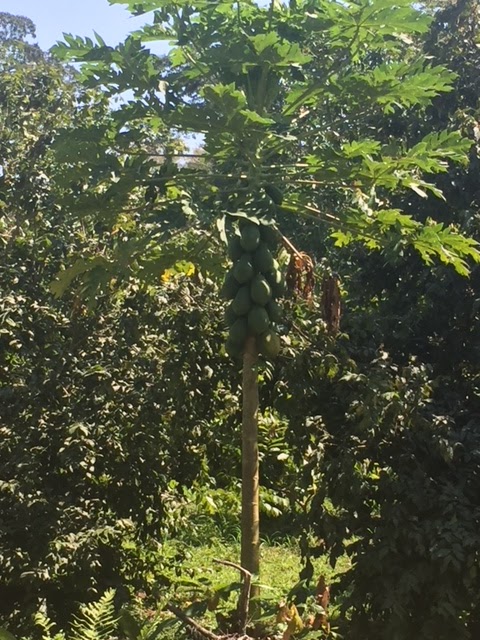
Yes, up early again and a short boat ride and walk took us to a covered shelter on the opposite bank of the Tambopata with a perfect view of La Torre clay lick.  At specific times of day, parrots gather in a nearby tree and then descend en masse to the clay lick.  They need the nutrients in the clay to be able to digest otherwise poisonous plants.  The birds we witnessed included dusky headed parakeet, orange-cheeked parrot, yellow-crowned parrot, Chestnut-fronted macaw, blue-headed parrot and Mealy parrot.  Armande and a fellow guide set up a camera on a tripod, so we were able to get close up photos of these breathtakingly beautiful birds.  Armande then took us to a local farm where we could see groves of avocados, bananas (many different varieties), papaya, corn, citrus, star fruit, pineapple, turmeric and of course, cocoa beans. He chopped down a huge bean pod and gently cut it in half with a machete to reveal huge white cocoa beans inside.  These beans have a sweet white coating and the bean itself is chocolatey-bitter.  
We then went back to the boat and out with the fishing rods.  Peter caught catfish - edible and non-edible varieties - and a pacu that he didn't manage to land.  In the afternoon was another boat ride and a short walk to Lake Tres Chimbadas. Aboard a catamaran, we went fishing for piranha. Peter used his extendable rod (no, not a euphemism) and I used a bamboo cane with a line tied on.  Peter caught several piranhas, and I just caught one, plus a small sardine.  My first ever piranha - a very proud moment!!  We spotted more giant river otters and Cayman, plus snowy egrets, hoatzin, short-tailed hummingbird and a nightjar.  There was an incredible iridescent bee gathering nectar from a local plant.  We settled down to watch another stunning sunset.  It's a hard life.


August 29
Up early as usual, a boat ride and a bumpy car ride back to Puerto Maldonado.  En route we were entertained by red and blue macaws and green parrots.  We said goodbye to Armande and Melo (boat driver/film star:  'Candamo la Ultima Selva sin Hombres') and flew off back over the Amazon to Cusco.

Thursday, 27 September 2018

September 2018

It's been busy off-farm for the last few weeks.  We had a very special holiday, celebrating Peter's birthday and our silver wedding anniversary, in Peru.  We'd been happily planning it for months, and it was truly amazing.  I'm hoping to do a separate blog about it soon.  Then I had some eye surgery to fix my foggy eye, and the world is now a much brighter place.


Work on the garden and the wine-brewing has been shoe-horned into the remaining time.  The Wairau Valley Garden tour is now less than 3 weeks away and I'm starting to panic a bit.  Spring marches on relentlessly, providing a myriad of cheery, vivid colours that add that ethereal element to the daylight.  The clocks change at the weekend, which will free up evening garden time.


The feijoa wine was bottled and it's really lovely.  It doesn't taste very alcoholic, so Peter took it to work and got the alcohol level tested - 12.5% - around the same as a commercial bottle.  The mead has been racked into clean demi-johns, leaving behind a thick layer of lees.  I'm wondering whether it's mostly yeast debris as I can't work out what the honey would break down into.  In terms of taste, the honeydew and manuka were the most promising, followed by the creamed honey and dark honey.  The only batch that wasn't very pleasant was the granulated honey.  It'll be interesting to see where they end up after a few more months.  

Another 2 batches (10 litres) of birch sap wine is also on the go.  Peter managed to tap the birch trees and we got heaps of sap.  It tastes like very slightly sweet, fresh water, so we're looking forward to seeing what that tastes like as a wine.  One batch is sweetened with honey, and the other with sugar.  It'll stay in buckets for a few more days before being transferred to demijohns.  There are lots of wonderful stories on the internet about birch sap wine that has made researching it entertaining.


Many vege seedlings are popping up in Madame Cholet, and a few have been big enough to plant out.  There are now broad beans, lettuce, beetroot and spinach in the garden, and the first round of early potatoes has gone in.  Several of the beds have been cleared of weeds - particularly persistent around the pathways and under the lavender that is patchy and spindly.  The lavender hedges will be replaced, but the cuttings of silver box that should have done so haven't really taken.  No surprises there because the parent plants are dead.  It looks like frost damage.  I'll probably end up taking cuttings of ordinary box, but hoping for a lightbulb moment as I'd prefer to plant something else suitable that I haven't already got.  
I have the ingredients and recipe for an organic weedkiller (Epsom salts and strong vinegar) that I'll use on the pathways in the horse arena.  The bigger weeds will be pulled up to reduce the organic matter, but here's hoping that the organic stuff works.  My knees are objecting to lengthy sessions squashed into gravel.  

The flower bed did finally get cleared, just in the nick of time before too much plant activity.  There are several flowers coming through, and the barley straw seems to be doing a good job of holding back the weeds.  The hedge is even starting to look hedge-like.  We're making some plans to build a deck at the back of the house, that will take out a big chunk of lawn.  Then we'll widen the flower bed.  Further along the garden, past the pizza oven, more plants have been added.  These include a couple of blackthorn trees (creator of sloes), shipped from the North Island, and some old familiar favourites from previous gardens (euonymus and flowering currant). 


Blossom continues to be abundant.  If I were a betting woman and based on blossom volumes, I'd say this year will be the Year of the Pear.  Not only is the Conference Pear tree smothered in white blossom, but so too is the Nashi (double graft) and the Packham.  At the vege garden entrance, both the Red Bartlett and the Williams Bon Chretien are in full bloom.  One of the original orchard trees, that has never successfully fruited and is possibly a greengage plum, is also flowering this year.  Here's hoping that their promise will eventually bear fruit!

The two hazelnut trees that we were gifted by our neighbours seem to be alive.  They line part of the driveway and are budding up beautifully.  The whole driveway is an overgrown mess and definitely needs some attention.  One day we'll get round to pulling up the raggedy hedge and widening the driveway.  It'll be an expensive and/or time-consuming job that right now is quite a way down the priority list.  Maybe 4 years away.


On the animal front, we've stopped feeding out hay as there's plenty of pasture.  The decision has been made to cull the ewes, and I'm leaving that to Peter to organise.  Yes, cowardly I know.  The decision about the cows will be much harder and we haven't gone there yet.  The bees seem busily fine, and I took a frame of bees and brood in our club's observation nuc to 2 local kindergartens as part of Bee Aware Month.  As expected, the kids were fascinated with the bees and adored the honey tasting.
Billy has been making progress with Lazy Mazy and she's now sporting her smart cream re-spray.  She looks really characterful.  He's starting to get on with the inside and will be using our old double bed mattress on top of a constructed base.  He's hoping I'll help with the curtains.  Maybe he's forgotten how bad I am at sewing, that years ago he sewed his own scout badges on because my efforts were too horrifying.


I'm looking forward to a few days work on the West Coast next week, which will leave agonisingly little time to titivate the garden.  The total garden list is unachievable of course, and I'm pretty crap at doing the important things first.  I'm much better at doing the enjoyable things first.
Que sera sera and all that.  Every day in the garden is a blessing but roll on the warmer, longer and balmier days.

Saturday, 11 August 2018

August 2018


It’s still a cold and wet winter, though those glimmers of spring promise are palpable in the rays of the dawn sun and the fattening buds of tree blossom and the flowers discovered hidden among the weeds.  Our neighbour (and my yoga buddy), Jane, keeps weather records and says that we were already beyond average total annual rainfall by mid-June.  I’m a bit over sloshing through the mud to feed the cows, but with a dry summer predicted, perhaps I should just get over it and indulge in the wallowing.

The ApiNZ conference went ahead on July 22-24, and was a fantastic experience with lots of positive feedback.  There were several hiccups, but no disasters, on the organisational front.  It’s a relief that it’s over, but I’m already missing being involved, especially spending time with the rest of the team (pictured: Lizzy Pllu, Karin Kos, me, Ricki Leahy, Betty Murie, Renee De Luca).  Derryn’s amazing bee-themed quilt raised a magnificent $900 at the Gala Dinner Auction for Life Flight. 

One of the benefits of the conference was a series of freebies.  Several items were secured on behalf of our local bee club, like 10 mesh hats that we can use at workshops.  I also scored 8 Manuka trees that were displayed at the Gala Dinner.  4 of these have already been planted in the unused section of the horse arena, where we plan to create another woodlot.  The piece de la resistance from the conference had to be securing the bulk of the honey competition entries.  Some of this honey is taken back by its owners, and the judges take batch samples back to the lab for testing.  But the remainder?  Apparently it’s a bit of a problem, easily resolved by the simple provision of a box.  Just put the unwanted honey in there please, said I.  

That’s what led to the mead.  Admittedly 43 litres might be a tad more than we technically need, but what an opportunity!  There are 5 litres each of honeydew mead, dark liquid honey mead, naturally granulated mead, and delightfully indulgent Manuka mead.  And 23 litres of creamed honey mead, currently brewing in a giant glass demi-john that I fell in love with when I was looking for yeast. I even enrolled professional help in the form of Molly, who’s just completed her wine-making degree.  She advised on yeast, yeast nutrients and citric acid, and came along to assist with the mundane task of emptying the honey pots and then magically setting off the process of turning water into wine.  Now there’s a symphony of delightful bubbling coming from the hot water cupboard.  Beautiful.

Creating space for the aforementioned mead meant bottling the incumbent elderberry wine in 3 demi-johns.  It was a pleasant surprise to find this wine to be completely drinkable, even at its tender young age.  The word on elderberry wine is to expect it to be repulsive until it reaches a reasonable maturity, when time transforms it into nectar.  Let’s hope that mine doesn’t work in reverse and get less drinkable as it ages.  The main issue here will be finding a way of avoiding drinking it all too soon.  That’ll mean hiding it from Peter.  Eh Peter?

My own honey supplies are dwindling, but next season’s supplies are looking promising as the hives are surviving winter admirably.  Unfortunately this also includes the bitch queen hive that I’d hoped would die out over winter.  In fact I was confident that it was no longer, as there’d been very little activity around the entrance.  I went in to check, and as soon as the hive lid came off, the noise erupted like a small aircraft.  Oh yes, they were live and kicking alright, and a brief inspection revealed plenty of new brood.  Bugger.  They haven’t lost any of their aggression either.  The photo outlines the perils of trying to evict a bitch worker bee from your hair before she stings.  Very attractive.

Meanwhile, more of the garden beds have been wintered down.  This includes all the vege garden and horse arena beds, and the herb and rose gardens.   The latter even received a very generous dollop of horse poo – such a waste of perfectly good poo, but gotta keep Karyn happy.  The Aloe Candelabra was a gift from our car mechanic (long story) and is planted next to the Yucca.  Another gift of some Aloe Vera came from a work colleague as trade for honey.   Still patiently awaiting attention is the last on the list - the flower bed.  I think I’m avoiding it as it looks like it might be a massive task, and I’ve run out of pea straw.  Hopefully I will get around to it before spring growth scuppers it all again.    

The worms in Worm Hollow are positively thriving.  There's lots of vermicompost for some spring seedling mix, and plenty of vermiliquid too.  The bath that houses Worm Hollow has done a great job - a very worthy end-of-life experience for any elderly bath tub.  It's lovely to see hundreds of red worms wiggling away through the compost that is simply kitchen waste.  Plenty spare for Peter to use them as fish food. 

The tea plants and the citrus were treated with an organic frost spray.  It seems to be working.  The tea plants are looking just fine and don’t appear to be affected by frosty mornings.  I haven’t been brave enough to remove the frost cloth from the citrus when frosty nights are forecast - not yet at least - but they are looking healthy.  It’ll be a while before the tea reaches hedge-like proportions and the citrus produce a decent crop.  It’d be great to keep them alive until then!

The cows are being fed out twice a day.  Half a bale each time from me, and a third if Peter’s dishing it out.  He points out they’re not exactly emaciated, a fair point.  But they do flash those cow eyes at me, and we have plenty of hay this year.  Hermes is the canniest when it comes to anticipating the exact location of the hay drop hay and being first in the queue.  Athena is usually the last to work out that grub’s up and how to reach it.  I’m wondering if she maybe lost a few brain cells during her difficult birth.  No cow babies though, so some difficult decisions may have to be made…


Mamma Mia 2 was released on Chick Flick night at the local movies.  I went along with some colleagues who have a penchant for dressing up.  A toe-tapping movie and a lovely night out – thanks Jill, Carol, Helen and Clare.


Spending time in the garden during warmer winter interludes is a real pleasure.  It’s not too hot and not many pesky sand-flies, and the soil is easy to work.  Fantails are constant companions, and Tuis are often around.  When it’s wet, the shellducks and kingfishers join in, and when it’s warm enough, honey bees too.  Dare I say it, most of the back-breaking work for winter is done.  The first spring foliar spraying of the fruit trees (with a heady mix of Effective Microorganisms, neem oil, fish, seaweed, vermiliquid and molasses) has even been completed.  The seed catalogues have arrived, been droolingly scrutinised, and an order placed.  Seed sowing is next up.  That never loses its shine.