Townie on a NZ smallholding

Townie on a NZ smallholding

Tuesday, 18 June 2024

June 2024


Work took me Inland in late May on quite an extensive road trip.  First a few days in Karratha with Peter, then he headed home.  I continued to Tom Price and Paraburdoo for a couple of days, and onto Newman, pictured from Radio Hill lookout, before eventually flying to Perth.  From Perth I had a ride with Sian (fellow metro-based midwifery educator) to the Wheatbelt town of Northam for a workshop.  Driving out of Paraburdoo, I came across this beautiful sculpture called 'Resilience'.  It's based on the spherical shape called the 'torus', which scientists believe best describes the dimensional properties of our universe, specifically as they relate to the Earth's magnetic field.  It also serves as a visual device for focusing attention on the surrounding rugged landscape.  It was constructed by the local community, "paying homage to the mining industry of the Pilbara, the people of Paraburdoo, local Indigenous culture, the unique beauty of the landscape and the spirit of regional communities in Western Australia".  What an awesome achievement for a tiny, remote community.  

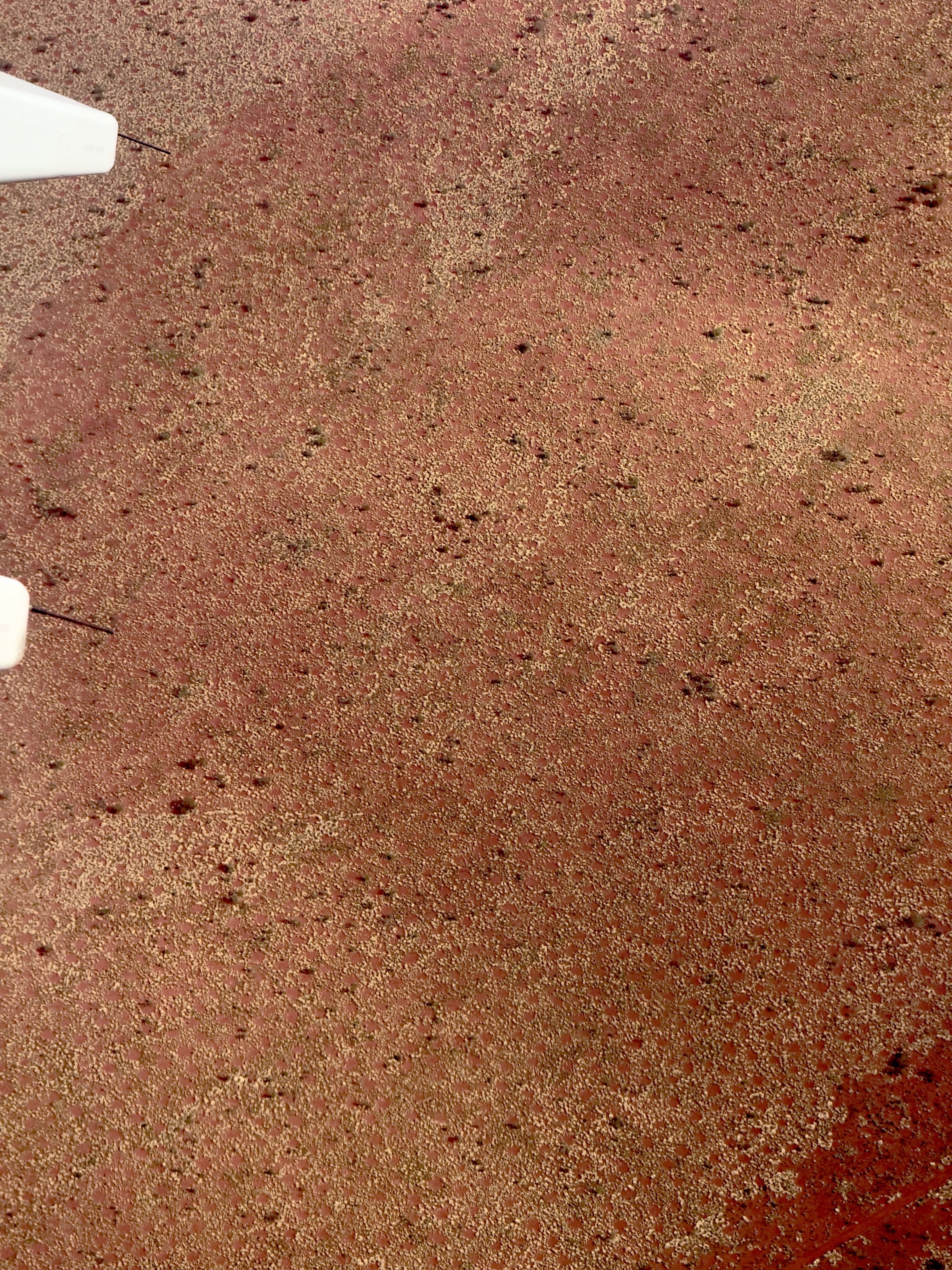
The flight from Newman to Perth took us over spinifex-covered red sandy landscape - lots of dots of colour like in Aboriginal art.  The spinifex turns from yellow to green with rainfall.  The photo doesn't do it justice but is a lovely memory for me.  After the workshop I managed to catch up with Melanie in Perth.  She took me to a German restaurant, hence the yummy wurst, sauerkraut and beer.  She's decided to return to NZ at the end of the year, so this may be the last time I see her in WA.  
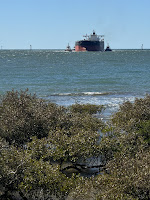
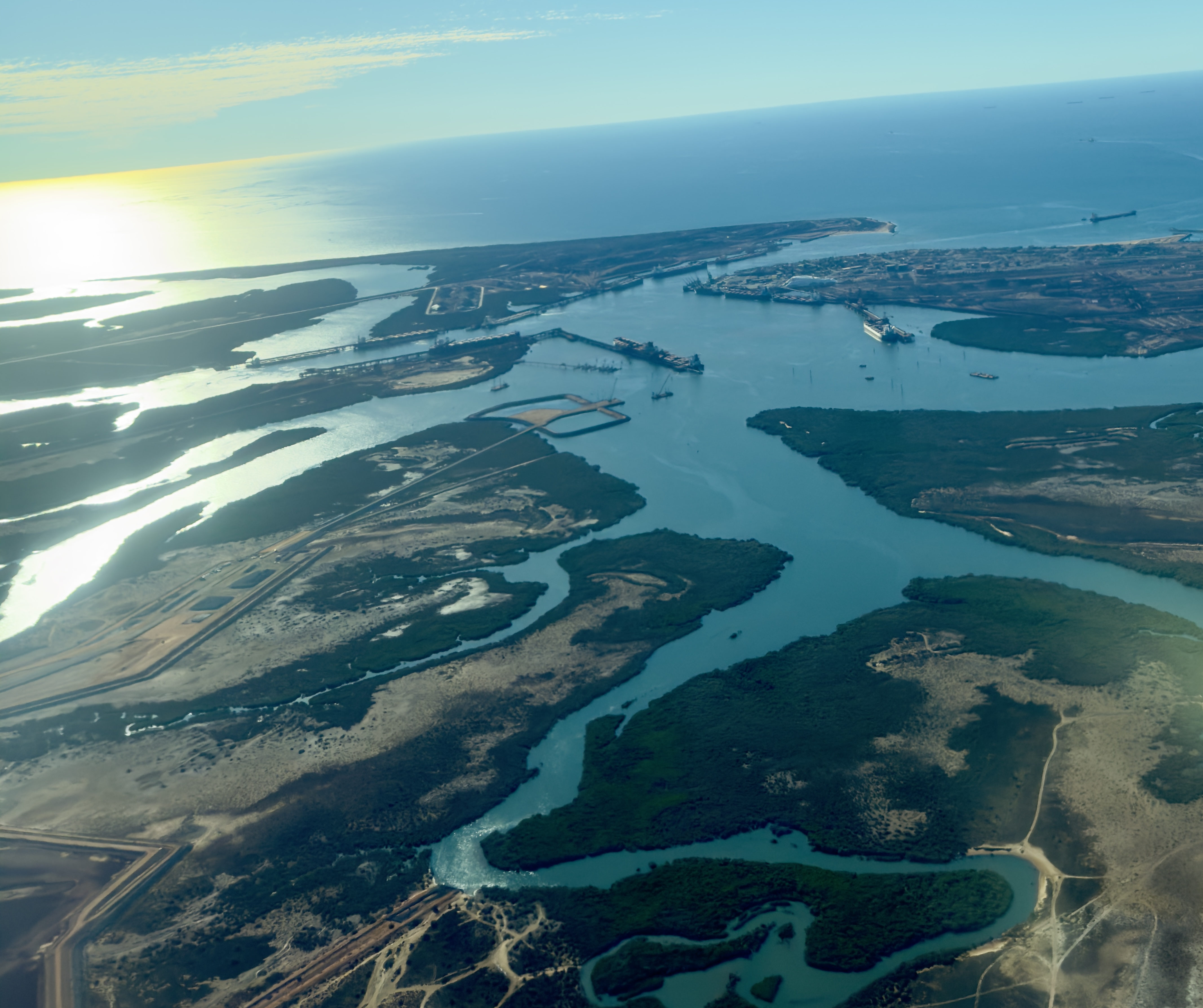
Our beach walks are continuing, and we can even get out in the middle of the day at weekends because it's winter.  Daytime temperatures have dropped to a dizzy late 20/early 30 degrees, and at night it's around the mid-teens.  That's meant we can now use a thin duvet rather than a sheet.  What a joy it is, being able to snuggle up to sleep!  And it's only early winter, so there's potential for things to chill even more.  The main downside is the shorter days.  Our weekday walks have to happen pretty soon after I get home from work.  Annoying bitey insects come and go, and that's frustrating as it's still a bit too warm to cover up in long sleeves.  We took a walk along the Hedland beach alongside the port and watched the latest bulk iron-ore ship come in, escorted by tugboats.  The route is tricky because of the reef, so they chopper out experienced ship pilots from Hedland to steer them in safely.  Several huge ships come and go every day - a massive logistical operation.

 
There seem to be less corals at this time of year.  Most are only visible at very low tide, so maybe it's more a case of timing.  For some reason, orange is the new black on the beach right now, even the starfish are sporting this season's colour.  Cemetery Beach is a good place to find them all, mainly because it's very accessible and a lovely walk whatever the tide is doing.  Octopus Soccer is still a thing, with one particularly high scoring game ending at 14:9 - to me!  I was way ahead for ages, then Peter had a sudden rush at the end.  Not enough alas, eh Peter?  As it's my blog, I don't have to point out how unusual that is...

                             
One of our Pretty Pool beach walks at low tide was particularly special.  We'd seen a large group (100's) of crabs once before in our very early days, and assumed it was a usual event.  But we didn't see it again until this walk, and this time it was millions of crabs making their way out further to the sea.  Walking along the sandy beach at low tide, we were suddenly aware that the ground was rippling.    At first, we thought it was us disturbing the crabs, but then realised that they were scampering everywhere all over the beach, as far as the eye could see.  No idea what we were witnessing.  There are reports of a mystery crab migration off WA's Shark Bay (possibly swimming out of the bay to less salty water to breed), but otherwise Google isn't telling us more.  It seems that much of crab culture is as yet unknown, but hopefully one day we'll find out what that was about.     

                            
Peter's still fishing a few times a week, and also catching.  Mostly he catches at Finucane but sometimes he's lucky at Cemetery Beach.  Tides, timing and wind combinations seem to make all the difference to success.  The filleted fish is a Tusk fish, aka Bluebone.  Peter's very good at filleting these days, and delish fish features heavily in our diet.  

 
This month my work road tripping has also taken me to Marble Bar and Nullagine.  Both small towns have Nursing Posts rather than health centres.  They're staffed by a single registered nurse who runs daily clinics and is also on call 24/7.  Each site has an ambulance that the nurse can use.  They should be supported by an enrolled nurse, but this is a bit hit and miss as skilled staff are not easy to find.  A doctor from the Royal Flying Doctors Service (RFDS) flies in to run a weekly clinic on both sites.  It's incredibly high skills and commitment territory for these amazing nurses.  Nullagine is a further 112kms from Marble bar, along a heavily corrugated and rough dirt road - bra tightening definitely a necessity!  The lovely Vangie accommodated Sonja (Regional Nurse Educator) and me in her Nullagine home as the only other accommodation option wasn't available.  She and her dogs Charlie and Noonoo provided totally awesome hospitality and even a sunrise tour of the surrounds which was surprisingly green and serene.  


Marble Bar, allegedly Australia's hottest town, was our next destination.  In January this year, Marble Bar ended a 26-day straight stretch of maximums over 43 degrees.  In 1923 and 1924 it recorded the longest heatwave - 160 days over 37.7 degrees.  Happily, it's winter and the day temperatures currently are similar to Hedland, and cooler overnight (yay!!).  We stayed in the iconic Iron Clad Hotel where we could enjoy the only bar in town.  Both Nullagine and Marble Bar were previously much bigger towns thanks to gold discovered in them thar hills in the 1890's.  Prospecting continues to be an actual thing that has quite a significant following, and there's still a working gold mine.  There are a few geological and scenic places around Marble Bar that I'd love to return to explore one day, including the huge deposits of jasper crossing the local river that were mistakenly believed to be marble back in the day, hence the town name.  We'll have to squeeze in a weekend in the roof top tent before Peter heads back to NZ.

                                                  
This inland trip was made more special because I managed to score a flight home with the RFDS doctor in this tiny plane.  Just a half hour flight, low enough to get fabulous views of the land.  Big swathes of iron ore deposits are clearly visible from the sky, along with several dry, tree-lined riverbeds.  The Hedland salt lakes soon came into view, and we flew right over the port before landing.   

                        
Another poor photo that serves as a reminder that we have been a bit social this month.  This was the stage for the Red Country Music Festival that was held in South Hedland at the weekend.  It was a day event with an impressive number of bands lined up.  The main draw card was Lee Kernaghan, Australian country music legend honoured in recognition of his support for rural and regional Australia.  Most of the crowd were familiar with his most famous tracks like 'Boys from the Bush' and 'The Outback Club'.  All the other bands were good too.  Great to have live music opportunities in such a remote place.  Everything outdoors seems to happen in these few winter months, and there are heaps of campervan visitors to Hedland making the most of the social events and pleasant temperatures.   

Another month rolls by, and we've been looking ahead to our next holiday to Broome.  We've booked a campsite for a couple of nights before checking into more solid accommodation when Clare and Roy arrive.  I'd have loved to get to the Bungle Bungles but that won't happen as there are too many logistics that take up heaps of time and money.  It's a shame but there's so much to see and you just can't do everything.  We're also counting down to Peter's return to Onamalutu in August.  One thing's for sure, he's gonna need plenty of firewood and warm clothes!

Sunday, 19 May 2024

May 2024


The World Heritage-listed Nyinggulu Ningaloo Reef is the world's largest fringing reef and one of its most important biodiversity hotspots.  
It makes for an indescribably awesome holiday destination.  It's about 1200kms from Perth and 800 kms (8.5 hours' drive) from Hedland - pretty standard traveling distances for WA.  We drove there over 2 days each way, stopping at Nanutarra Roadhouse by the Ashburton River on the way over, and Karratha on our return.
Exmouth is the nearest town (population 3200) and is well set up for visitors to the reef.  It was originally built to support the US Harold E. Holt Naval Communications Base.  Integration with local Australians was a deliberate strategy to promote Aus and US collaboration at the start of the Vietnam War.  The base itself was known as a 'Little America in Western Australia'.  American currency was used, and US cars drove on the right side of the road.  American food was shipped in and there was a bowling alley and baseball pitch.  It was handed back to the Australian Navy in 1992.  It features thirteen tall radio towers that provide very low frequency radio transmission. The tallest is 387.4 metres (1,271 feet) high and was for many years the tallest man-made structure in the Southern Hemisphere.  It's a very odd addition to the landscape, but despite the height, doesn't dominate the landscape along the Ningaloo itself.


Most of our route to Exmouth was along the North Western Coastal Highway.  The last 80kms after turning off the highway goes up the peninsula to Exmouth, and the landscape for much of the way is very characteristic.  Lots of red sand, but also plenty of green scrub despite being very dry.  Much of this landscape is punctuated by termite mounds, thousands of them.  In Karijini, the mound shapes are very womble-like, but here they're more like giant boobs topped with a distinct nipple shape.  Curious.  So curious in fact, that there is even a brown tourist sign (identifying an interesting destination or place of interest) to showcase them.  I can only hope there was robust debate in council chambers about whether or not they could get away with calling termite mounds a tourist attraction.
For the first few nights we stayed in Exmouth's Osprey Village, easily walkable to the vibrant town centre.  We soon came across the Whalebone Brewery and Ningaloo Distillery, a great pub vibe with beer and gin tastings and good food.  We were lucky to be there for live band 'Toby Beard'.  All up a great night. 
The first day we headed out of town and along Yardie Creek Road, which tracks down the Ningaloo peninsula coast.  It's a glorious drive with the deep blue ocean and white sand dunes on one side and the rugged Park Range National Park on the other.  And an occasional emu.  Numerous small sandy tracks towards the sea provide parking zones and beach access.  Like elsewhere in WA, there are hidden surprises and there is hardly any shelter anywhere.  The Milyering Discovery Centre provided a good opportunity to get a cold drink and get out of the sun for a while (yep, still well above 30 degrees).   
We parked up at the aptly named 'Turquoise Bay', clearly a popular destination and for very obvious reasons - it took out the Number 1 spot in the Top 10 Beaches in the South Pacific and came 3rd in the top 25 Beaches in the World in Tripadvisor’s recent 2022 Traveller’s Choice Awards.  For us, it was the first of many fantastic snorkelling opportunities.  You just step into the sea and put your face in the water, and a whole new underwater world immediately appears before your eyes.  Fish of all sizes and colours swimming among abundant corals.  The corals themselves are in sub-tropical waters and are not colourful like those on the tropical Great Barrier Reef.  They can thrive in a wider range of water temperatures and are considered to be healthier and more robust than those on the east coast.  They are endlessly fascinating, and their vast variety of structural forms totally makes up for their limited colour palette.  The whole snorkel experience is completely mesmerising and addictive - so much to be curious about and absorbed in.  Totally a happy place for my soul.

               
The next day was our holiday raison d'etre - swimming with whale sharks.  Another bucket list opportunity that really is as fantastic as it sounds.  The sea conditions were good, and we headed out beyond the inner reef to deeper waters.  We practised getting in and out of the sea in groups and instructed on how to behave when whale sharks are nearby.  Peter sat this one out though did join us for some later snorkelling.  A spotter plane notifies the boat when a whale shark is around, and on our trip, there were 5 whale sharks in total, including those in the pics.  They swim effortlessly and slowly enough for us to swim alongside and don't seem perturbed by the presence of humans.  Then when they're ready, they just dive down until they disappear.  They are unimaginably serene, graceful and fascinating, and things there are no words for.  What a sublime privilege to be with them.  
Peter went on a fishing charter the next day, and I just happily pottered around Exmouth and Ningaloo.  He got to see plenty of sea life including dolphins, and his catch of the day was this 67cm Golden Trevally.  It was one of the fish that he managed to get past the marauding sharks who were grabbing fish off the lines.  He also brought back a Pearl Perch, considered one of the best eating fish in Australia.  They provided plenty of fish dinners for us.  A very colourful trigger fish was returned to the sea (good-looking fish but not good eating).  
The next day we checked out of our unit, and later checked into the RAC Caravan Park where we spent 3 nights in the comfort of our rooftop tent.  The tent is surprisingly comfortable and spacious enough (like a double bed), but sleep was thwarted by high temperatures and humidity, especially during the second night.  Allegedly it's been an unseasonally hot autumn in WA, with temperatures several degrees higher than average.  Guess we have climate change to blame for that.  

                                                 
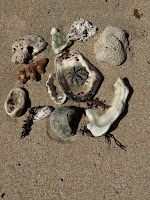
We spent another day exploring the top of the peninsula.  In 1907 a cattle steamer, the SS Mildura, was wrecked during a cyclone.  The crew were rescued but hundreds of cows were sadly left to die on board.  The ship remains are about 80m from shore and it's a popular diving spot.  Whilst we were taking in the view, we spotted a large sea creature relatively close to the beach.  On closer inspection, it was 2 creatures - a mother and baby dugong - gently swimming to and fro along the shoreline.  Another amazing highlight.  We stopped at a couple of stunning beaches along this northern stretch of the Ningaloo, pottering on the beach, playing with shells and washed-up corals and enjoying the magical vastness and the isolation of the landscape.  Time well-wasted.


Another day we went all the way down Yardie Creek Road to where the road ends.  En route we stopped at Oyster Stacks beach, a recommended snorkel zone.  Possibly the best snorkelling experience ever despite very stiff competition.  You can only snorkel at high tide to protect the shallow corals from people standing on them.  So many gorgeous fish, corals and a few turtles living among the oyster-clad rocks.  Even a small octopus swimming stretched-out alongside a similar-sized fish - it took me a moment to realise that it was an octopus.  I could've stayed there forever immersed in the sheer gorgeousness of the scenery. 
The deep blue water of Yardie Gorge winds its way from deep within the Cape Range through the ancient landscape to meet the Ningaloo Reef.  It's bordered by red limestone cliffs and an array of birdlife and wildlife.  A short (2km), scrambly walking track makes its way along the gorge rim, providing stunning views of the creek, the ocean, the rugged ranges and a few spring flowers.  Probably best not done in the midday heat, but that's when we were there.  
On our last Exmouth day, we went back to the northern stretch of coastline to find an isolated beach that we'd spotted previously.  Peter thought its rocky reef edge could make it a good place to fish, and sure enough, he landed this impressive chevron trevally.  We set up the shade tent, and I kicked back in there a while before heading out to snorkel again.  Another smorgasbord of colourful sea creatures, including a large octopus (about football size) that pretended to be a rock and gave me a huge fright when it stretched one of its legs out.
We decided to do a small hike - the Badjirrajirra Loop Trail at Charles Knife Canyon in the Cape Range National Park before leaving Exmouth.  It's a 6km walk of moderate difficulty (class 4) that should take about 3 hours.  Unfortunately we took a wrong, but scenic, turning when driving to the start of the walk, so instead of starting at 8am like we planned, we ended up setting out at 10am, passing a few other walkers who were making their way back to the car park.  We had plenty of water with us, but a lack of shelter and lots of flies meant that stopping was very unpleasant.  Though it wasn't hard walking, as we approached the last 500m I became increasingly breathless until I could barely catch my breath at all.  I crashed down onto a lone bench and nearly passed out, then started retching.  Peter went ahead briefly and spotted that we were only about 20m from the car.  He managed to drag me there and I retched repetitively for a while before nodding off to sleep.  It was scary how suddenly these symptoms of heat exhaustion hit me.  I had been feeling hot (more than usual) for a while but totally missed the warning signs.  A shame that my memories of what was otherwise an outstanding route are marred by my own stupidity.  Let's hope I've learned my lesson.   

150kms from Exmouth is the small and very charming Coral Bay.  I didn't see much of it the day we arrived as I was still recovering from my heat exhaustion experience and slept for hours.  We took things easy the next day, exploring this small tourist mecca and working out what we really wanted to do.  Bill's Bar was a lovely spot for some R & R.  We booked onto the half day glass-bottomed boat with turtle swim tour the next day.  What a treat that was.  The view through the glass bottom was crystal clear, way better than we'd imagined.  The coral reef in this part of the Ningaloo is particularly dense and it's like an endless underwater garden.  There were sting rays and turtles, and heaps of fish, including large spangled emperors.  Snorkelling in this environment was epically incredible too.

                 
We had enough time for one final adventure, and it had to be swimming with manta rays.  The boat headed out to the deeper water past the inner reef.  Another practice snorkel, this time looking down on a shark 'cleaning station' - where sharks and other large fish go for 'salon' sessions with cleaner wrasses.  Unfortunately there were no shark appointments while we were there, but it was still a fab snorkel.  We all boarded the boat and headed off, and before long the unmistakable shape of a 3m tiger shark appeared in seemingly shallow water.  Quite beautiful (from the safety of the boat at least).  The tour operators say that local sharks are so well fed on turtles, they don't go for humans.  Well, we must have all believed them, because soon after the plane spotters had a manta ray sighting and we all jumped enthusiastically in.  At one stage there were 3 mantas together, all swimming gracefully and slowly enough to keep up with.  Another extraordinary spiritual experience with these gentle giants. 

                 
Peter had intended to swim with the rays, but the distances involved were too far.  The tour staff kindly offered him an opportunity for a private viewing.  They positioned the boat so that he didn't have to swim far, and he was able to watch 2 manta rays right beneath him. 
We were keen to see a real West Coast sunset, and Coral Bay gave us an epic opportunity.  A spectacular bright orange sun, turning the whole sky pinky red for ages after the sun disappeared.  Thanks Coral Bay!
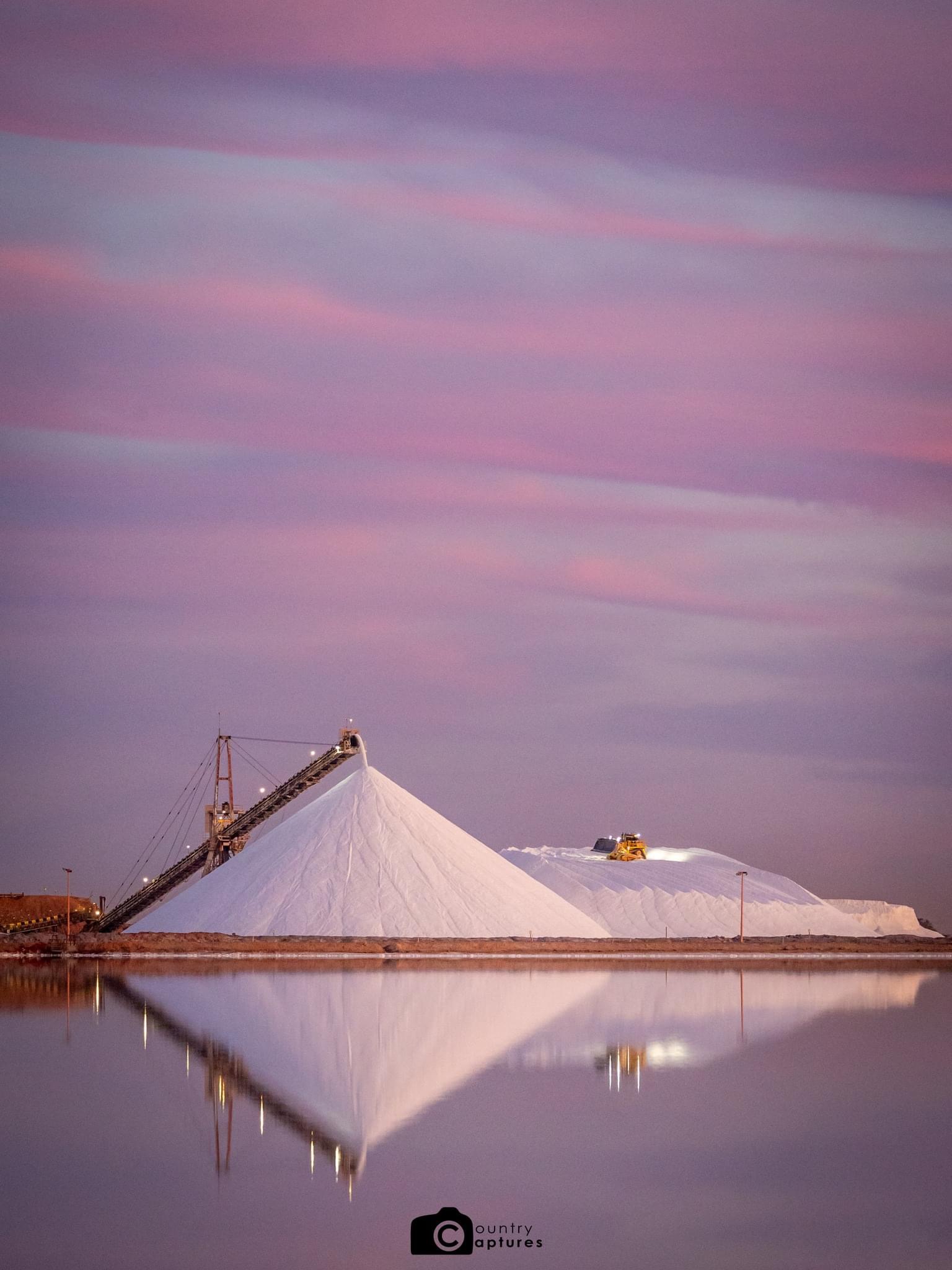
And talking of sunsets, there was a glorious Hedland sunset on the night of May 11th.  We were on a twilight tour of Port Hedland and this first pic was taken from Finucane Island.  We were pretty chuffed about this until the photos of the Aurora Australis and Borealis started to pop up.  It feels like North Western Australia was one of the only places in the world to miss out.  So yes, very jealous indeed.  The photo of the Hedland salt works is lovely, but not mine.  And I had to include someone's stunning photo of the Church of the Good Shepherd in Tekapo, backlit by the aurora.  Maybe next time...
Back in Hedland, my table loom has finally arrived.  I've set it up and am taking the first tentative steps in weaving.  Apparently, it'll be a scarf, but mostly it's an opportunity to get familiar with the equipment and process.  I'll be in Perth later this month and hope to pick up what I need for the next project.  I have mental plans to grow plants for fabric dyes when I'm back in NZ, so hope these skills will eventually dovetail into something that'll keep me out of mischief. 

So many photos this blog, which I hope will trigger happy memories of an incredible holiday for many years.  Back to work for now and nearly time to start thinking about our Broome holiday coming up in July.  How we're suffering!